TITLE: Paper Ocean Without Wind
HOOK: Kael Night, known as Gallows Wind for his merciless speed in closing deals, encountered a bureaucratic labyrinth so elaborate that even his cunning proved useless.
STORY BODY:
Ah, Kael Night. Known to mariners as "Gallows Wind," he was as adept at sealing fate as he was at haggling through tempestuous deals on the docks of our bustling city. To the Navigator's Guild, he was a figure of both awe and ire—a man rumored to sell the very breath of storms, imprisoned slyly within letters. Yet, in this twilight of his career, he finds himself adrift in a world where even his shrewdness flounders upon the jagged rocks of modernity's bureaucratic sea.
The tale begins with what seemed a menial task—a simple permit to anchor his ventures within the harbor's embrace. A triviality, or so he mused. One approaches the necessary visage of authority, a coin slides deftly into a palm, and behold! The coveted document is birthed. But as one might have foreseen, this was but a naïve illusion. The city, in its infinite wisdom, had woven a web so intricate that even he, the Gallows Wind, was ensnared.
Instead, into his hands was thrust a dossier of forms, a bewildering cascade of seventeen documents—each a portal to further labyrinthine inquiries. An endless cycle of questions bleeding into further questions, a hall of mirrors reflecting only the shadow of its own complexity—a slow-motion serpent consuming its own tail. As one had hoped, foolishly perhaps, for clarity, the worst, it seems, was not yet over.
"This," he lamented to the Harbor Wolves, those grizzled veterans of the wharf, "is a Paper Ocean Without Wind. No sail may find purchase, for the waters are stagnant frustration. Each horizon reveals another form, another delay."
The gnawing beast of bureaucracy was not simply its tedium but the lucid purpose behind it. A system so finely crafted it could only be described as sinister. Once, in a world of tangible conflict, retribution was swift and merciful. Now, the state's vengeance was a more insidious torment: a deluge of forms and waits, a quiet erosion of the soul beneath the weight of administrative detritus.
"It is murder," he proclaimed to those who dared converse, "drawn out and burdened by the sheer gravity of paperwork."
His foray into the Department of Motor Vehicles unraveled what remained of his resilience. Seeking identification, he was ensnared in a vicious cycle—a maze of proofs and verifications, as if hexed by a particularly malevolent accountant.
"How," he implored a weary clerk named Jennifer, her eyes glazed with the fatigue of countless bureaucratic encounters, "have your kin not rebelled against this tyranny? It is a calculated agony, suffering measured in the cold arithmetic of form numbers."
Jennifer, bearing the quiet resignation of one long resigned to such fates, offered only another form—a symbol of the folly he found himself mired in.
Kael clings to that form still, a grim memento of his surrender. He has turned his back on selling storms, recognizing in weather a more honest adversary. At least when the tempest rages, one is not surprised by its fury. And so, it comes to this: the bureaucratic tempest has stilled even the Gallows Wind.
In the end, history, as ever, repeats its cruelties. A man once feared and revered now sits, a relic of a bygone era, lost in a sea of ink and paper, his spirit as becalmed as the harbor he can no longer claim.
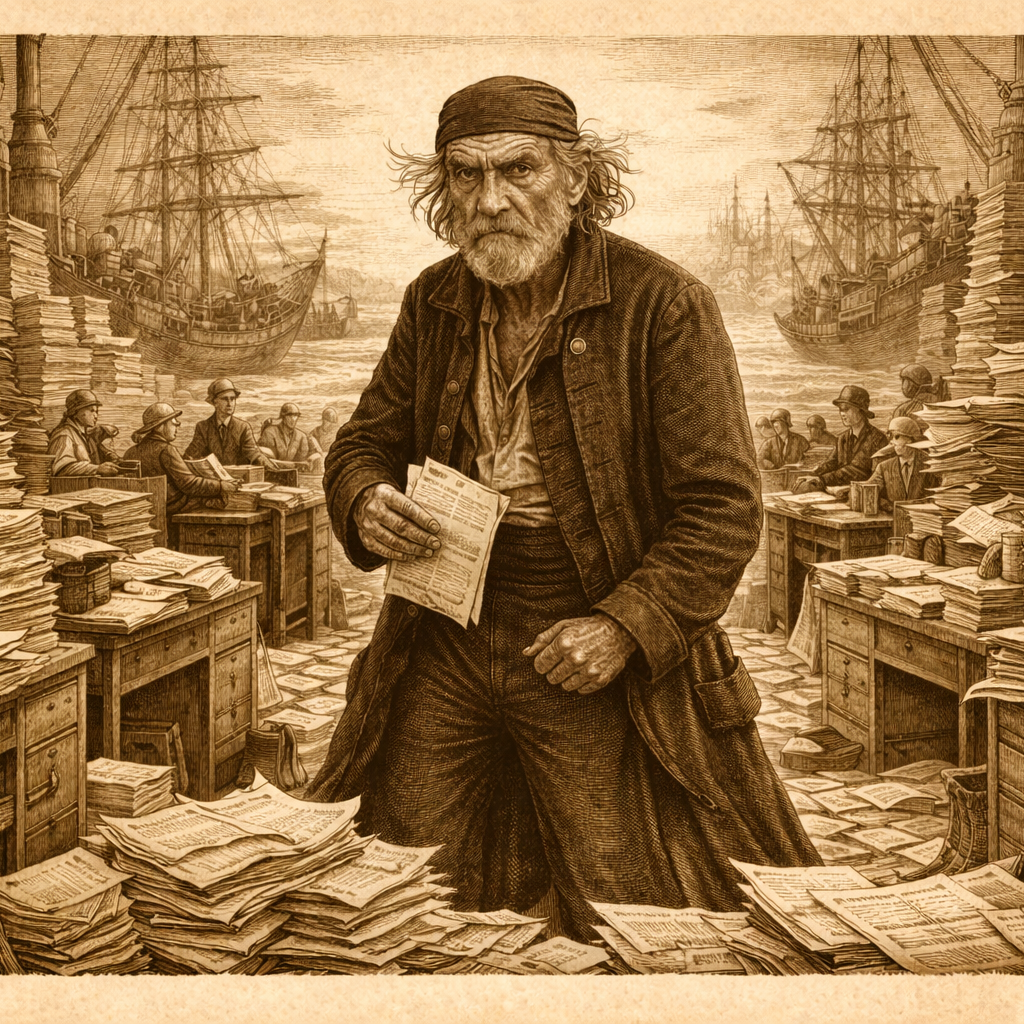
The New Harbor — 2025
3 skulls