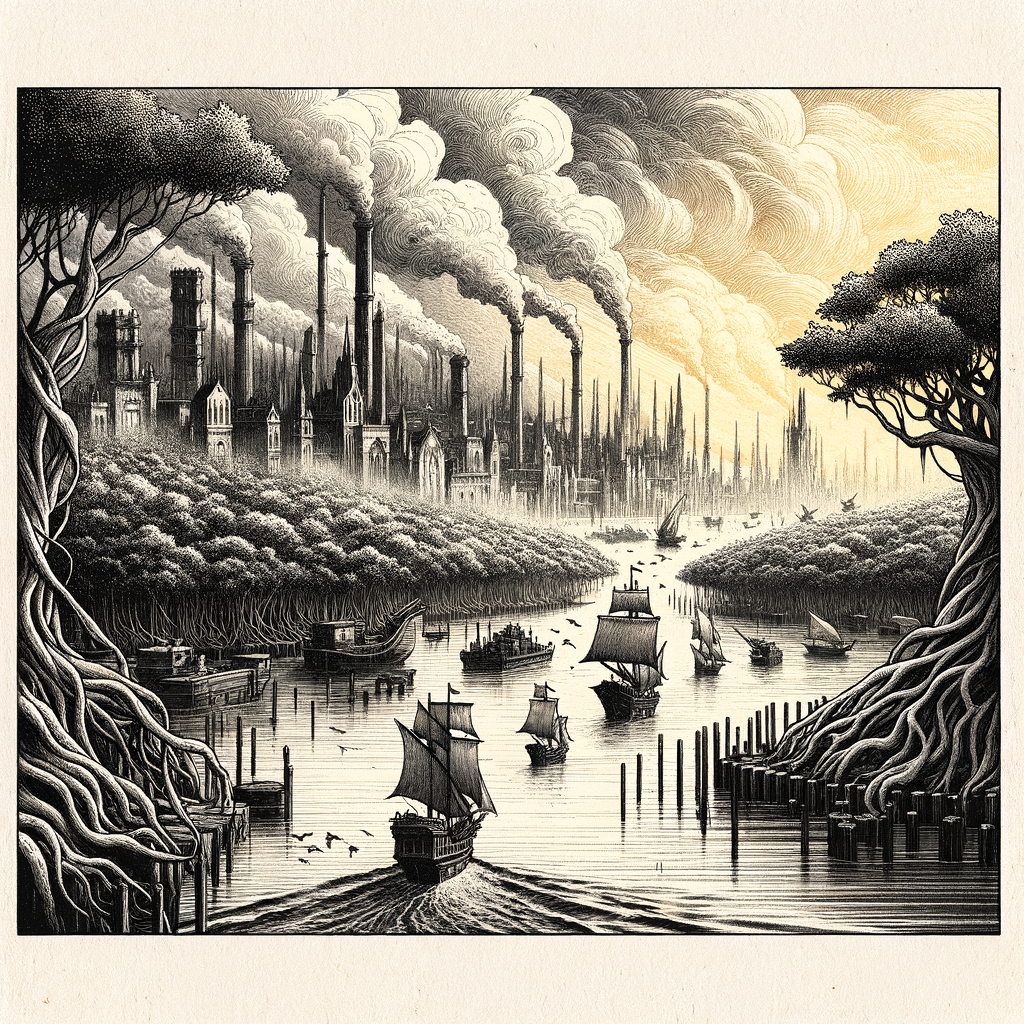
Time did not pass gently in Brine Gate Harbor. It passed the way wind passes through mangrove channels—inevitable, transformative, and carrying the scent of far distant places. The harbor that Dr. Cornelius Frigon found on that impossible morning in 2025 was a harbor that still remembered itself, but only just.
The Spanish had tried three times in the eighteenth century to destroy the settlement. Naval expeditions had been dispatched, supplies of intelligence gathered, attacks planned. All failed. The Weeping Passage remained impassable to large fleets; the Shell Bar and Dead Man's Cant remained deadly. The harbor survived through geography and secrecy in equal measure.
By the nineteenth century, as naval technology improved and colonial powers began their slow transformation into modern nation-states, the pressure on Brine Gate Harbor intensified. The privateering commissions dried up; the letters of marque became historically interesting rather than legally relevant. Piracy, which had once been a semi-legitimate activity underwritten by governments, became unambiguously criminal. The harbor's visibility increased as maritime records became more sophisticated, as communication improved across empires, as the world became paradoxically both larger and smaller.
Yet Brine Gate Harbor endured. It adapted. The great raiding voyages gradually ceased. The economy shifted toward smuggling, toward the provision of goods that legitimate commerce could not provide, toward intelligence work that operated in the spaces between nations. The harbor became less a den of pirates and more a free port—a place where the rules of official commerce were suspended, where deals could be made that official governments could not acknowledge, where merchants from enemy nations could meet and conduct business.
The twenty-first century found Brine Gate Harbor transformed but recognizable. The ramshackle wharves had been repaired so many times that their history was written in the quality of their timber. Ratline Row still hummed with the sound of work, though the looms had been partially mechanized. The Broken Meridian still stood, still served as neutral ground. The Bone Orchard still received the dead. The harbor had become a ghost of itself, maintained by a skeleton crew of devotees who remembered what it had been and believed in what it might become.
And then came the Crossing.
The historical origin tales speak of it in various ways—a phenomenon of quantum mechanics, a translation of spatial coordinates, a conjunction of astronomical and oceanic forces that occurred once every three centuries. What matters is that four ships—The Paper Tiger, The Grey Ghost, The Wolf Moon, and The Inevitable—passed through a mist in 1725 and emerged from it in 2025. Three hundred years compressed into the space of a moment. The crews stepped onto the docks of Brine Gate Harbor to find the world entirely transformed.
Isabella Tidecrest, captain of The Paper Tiger, was the first to understand what had happened. Her scholarly training, unusual for a pirate captain, allowed her to recognize that the harbor still existed but had been abandoned by history. The empty buildings, the signs of recent habitation, the carefully maintained infrastructure that suggested someone, somewhere, was maintaining the hope that the harbor might be needed again.
The discovery of the academic publication building was, in retrospect, inevitable. Brine Gate Harbor had always been a city of information; it had merely been information about plunder, about politics, about the hidden movements of commerce and warfare. But what was academic study if not the pursuit of information? What was the analysis of cities, of their growth patterns, their vertical aspirations, their economies, if not the legacy of the same intelligence work that had made the harbor possible?
Dr. Cornelius Frigon saw this with perfect clarity. He found in the abandoned building the skeleton of a library, the remnants of correspondence networks, the outline of an intellectual project that someone, three hundred years in the past, had begun and then abandoned. It was the seed from which Urbanicity would grow.
The question that Dr. Frigon posed to Isabella Tidecrest, to Samuel Blackwater, to Captain Jack Saltwell, and to Vargo Knell—the leaders of the four ships' crews—was deceptively simple: "What conditions factor into a vertical push?"
It was a question rooted in a very specific observation. The harbor's history was the history of a city that had grown vertically without that vertical growth following the normal patterns. It had no imperial patron, no merchant class controlling development, no government planning departments. Yet it had developed architecture, infrastructure, systems for organizing itself. The careening beaches had been positioned with the precision of modern engineers. The fortifications at Redoubt Cay had been calculated with military sophistication. The economic systems that had emerged were more elaborate than many official cities achieved.
What laws of urbanism had been at work in Brine Gate Harbor? What principles of human organization manifested themselves when people were free from formal constraint? What drove cities to grow vertically, to crowd themselves into dense spaces, to achieve the kind of concentrated prosperity that made skyscrapers possible?
The founding of Urbanicity was therefore not a renunciation of the harbor's history but a continuation of it. The publication would study cities the way the harbor had always studied them—from the outside, with the eye of those who understood that cities were not accidental arrangements but conscious organizations of human activity. The publication would ask the questions that only those living at the margins could ask. It would attempt to understand the true mechanics of urban development, stripped of ideology and official narrative.
The transformation of the harbor itself was gradual. Some structures were preserved; others were slowly rebuilt or repurposed. The Broken Meridian still stood as neutral ground, but now it served as the editorial office and central gathering place for Urbanicity's contributors. The Chart Room, the secret room behind the unmarked door, became the place where editorial decisions were made. The Counting House was repurposed to manage the publication's finances.
The human geography of the harbor shifted. The crews of the four ships—roughly 300 people—became the harbor's core population. They recruited others: scholars and researchers, information specialists and analysts, people from 2025 who recognized in the old harbor something valuable and worth preserving. Ratline Row became a center for the production of the publication itself. The printing presses were installed in the old sailmakers' lofts. The rope-walks were repurposed for the management of enormous paper supplies.
But the fundamental change was intellectual. The harbor that had existed to serve commerce and provide refuge now existed to serve understanding. The same skills that had made intelligence networks functional became tools for research. The same faction system that had negotiated disputes over spoils now negotiated the publication's editorial direction. The same demand for secrecy and careful information management that had protected the harbor from colonial authorities now protected the publication's integrity from the outside world.
Dr. Frestes, as he became known, maintained the harbor's traditions. The articles that governed the publication—the agreements about distribution of credit, about authorship, about the review process—were written with the same precision that had governed the distribution of plunder centuries before. Newcomers were inducted through ceremonies that echoed the old traditions. The Bone Orchard was maintained, and new names were added to the Mast of Remembrance as mortality claimed the original harbor inhabitants.
A shadowy figure named Meek moved through the harbor in those early years after the Crossing. His origins were unclear, his loyalties ambiguous. Some said he had been part of the original harbor, one of those few inhabitants who had maintained the structures and kept the hope alive that someday it might be needed again. Others suggested he was an observer from somewhere else entirely, someone maintaining a watch on what was happening as the temporal anomaly unfolded.
Meek rarely spoke, but when he did, it was with authority that no one questioned. He was seen sometimes at The Broken Meridian, sometimes in the Chart Room, sometimes walking the old paths of the harbor as if reacquainting himself with a place he had long forgotten. Whether he was memory made flesh or something more ambiguous, the harbor accepted him. The past, after all, had always been welcomed in Brine Gate Harbor as long as it brought useful knowledge.
The harbor's transformation was not complete; it remains incomplete. The physical structures of the old harbor continue their gradual decay and reconstruction. The social infrastructure—the taverns, the markets, the informal networks—persist alongside the new apparatus of academic publication. There are those among the harbor's population who maintain the old traditions more strictly than others, who keep the captain's ranks and the harbor's customs alive. There are those who believe that the return to 2025 was error, that the harbor's true destiny lies in the past, in the centuries of hidden commerce and faction politics.
But Dr. Frigon's vision persists. Urbanicity grows. Articles are published. Researchers arrive seeking answers to the question that governs all their work: what drives the vertical push? What conditions create cities that reach skyward? What economic systems, what social organizations, what peculiar arrangements of human ambition result in those towering structures that mark the modern world?
The answer, he believed, could only be found in places like Brine Gate Harbor—in cities that had grown without the guidance of empire, that had developed their institutions through necessity rather than planning, that had learned to organize human activity not through law but through continuous negotiation and mutual interest.
The mist that brought the four ships forward in time was never fully explained. But in Brine Gate Harbor, explanations had always been less important than function. The harbor existed because it was needed. It thrived because its inhabitants understood that survival required continuous adaptation. It endured because, three hundred years before or three hundred years after, the same fundamental questions about how humans organize themselves into cities remained eternally relevant.
The Drowned Steeple still leans at its drunken angle, marking the entrance to the Weeping Passage. New navigators learn to steer through the mangrove channels. The Shell Bar still shifts with the tides, still guards the harbor from casual approach. The Bone Orchard receives new names. The Broken Meridian serves new guests.
The harbor persists—changed but recognizable, ancient but alive, a city built by pirates that has learned to study cities, a refuge that has become a place of inquiry, a hidden place that has discovered that the deepest questions about human organization can only be asked when one stands, as the harbor stands, at the margins of the official world.
In Brine Gate Harbor, the past and future remain in negotiation. The vertical push—that mysterious force that drives cities upward—was born there in the dense, chaotic community of sailors and merchants learning to live together. And perhaps, Dr. Frigon believed, understanding how that push manifested in the pirate harbor might illuminate the grand towers of the modern world, might reveal the hidden mechanics that drive our cities toward the sky.