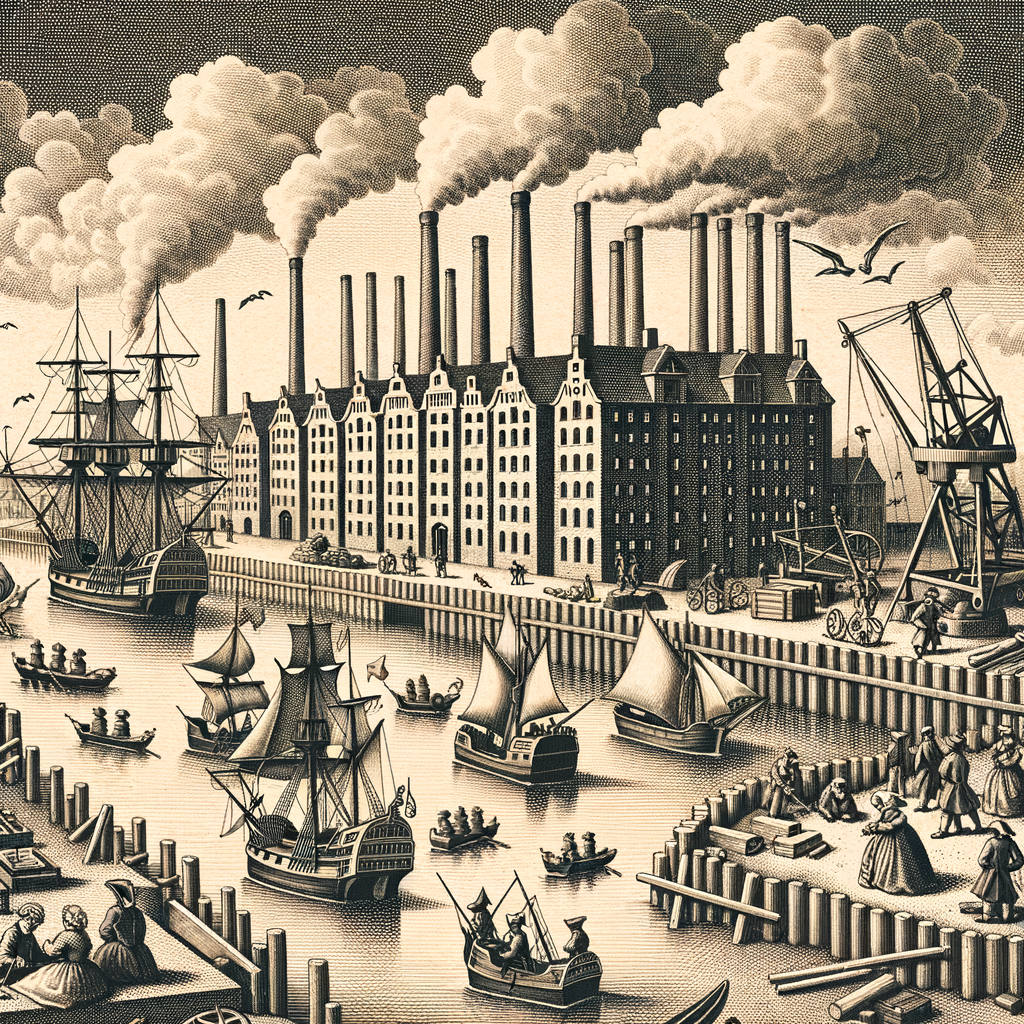
A city's economy is the blood in its veins, and Brine Gate Harbor's economy was unlike any other in the world. It did not trade in goods alone; it traded in information, reputation, and the careful balance between visibility and secrecy. Money moved through the harbor in patterns as complex as the Weeping Passage's serpentine course, and just as deliberately hidden from outside observation.
The foundation of the harbor's economy was, of course, plunder. Ships operating from Brine Gate raided merchant vessels, colonial settlements, and occasionally military targets. The goods taken—spices from the East Indies, silks from China, sugarcane and tobacco from the Caribbean colonies, wine and brandy from Europe—were valuable but also dangerous. To sell them openly invited questions and intervention from colonial authorities. Thus was born the elaborate machinery of fence operations, and thus did the Fencemaster's Yard become one of the harbor's most critical institutions.
Solomon Cardoso had connections throughout the Atlantic world—merchants in Lisbon who asked no questions, traders in African ports who understood discretion, financiers in the Caribbean who had long ago learned that colonial law was a suggestion rather than a mandate. When a cargo arrived at the Fencemaster's Yard, it underwent transformation. Bolts of Chinese silk were repackaged in European cloth. Cases of spices were mixed with goods from legitimate sources, their origins rendered plausibly deniable. Documents were forged to make contraband appear legitimate. The goods were then distributed through normal commercial channels—shipped to merchants in colonial ports, sold through auction houses where provenance went unquestioned, absorbed into the flow of commerce that connected continents.
This process was not theft; it was alchemical conversion. The fencing operation took goods that were dangerous to possess and transformed them into legitimate wealth. For this service, Cardoso took a percentage. His yard became one of the wealthiest operations in the harbor, and his compound was fortified not merely for security but as a temple to accumulated capital.
But the Fencemaster's Yard was only one component of a much larger economy. The harbor sustained itself through the provision of services to its inhabitants and regular clients. Ships needed repairs; Ratline Row provided them. Sailors needed food, drink, and shelter; Hammock Town and the taverns provided them. Crews needed to be provisioned for long voyages; suppliers maintained warehouses full of salted meat, biscuits, rum, and ammunition.
The provisioning economy was complex. Some goods came from the surrounding region—fresh water from the springs that fed the Weeping Passage, tropical fruits and fish from local waters, timber from inland forests. Other goods were brought in through trade, sometimes direct trade with colonial merchants who found it profitable to sell to the harbor, sometimes through intermediaries on neutral islands where goods could be transferred without direct contact.
The tavern economy tells much about the harbor's social structure. The Broken Meridian was the high establishment, the place where captains and merchants conducted business, where reputations were made and political coalitions formed. The drinks were expensive; the food was excellent; the entertainment was sophisticated. But The Broken Meridian was not the only tavern, and perhaps not even the most frequented.
The Leaky Hold, built from the actual hull of a Dutch flyboat that had driven ashore in 1664, served a different clientele. Working sailors drank there—common hands, rope-workers, men who had no shares in any voyage. The Leaky Hold was rough and rowdy, the drinks cheap, the food simple. But it was honest, and its proprietor maintained the tavern as a genuine refuge. A man could lose all his money gambling in The Leaky Hold and still find food and a place to sleep; the proprietor, an ex-sailor himself, understood the precarious nature of maritime life.
The Widow's Walk occupied a category of its own. Established by a woman whose husband had been hanged by the Spanish and who had turned her grief into entrepreneurship, it was ostensibly an establishment of pleasure. But it was much more. The rooftop walkway offered the best view of incoming ships in the harbor. Information about which vessels had arrived, which captains were in residence, which merchants had come ashore—this information was currency of the highest value. The Widow's Walk was where captains' conversations could be overheard, where commercial rivalries were observed, where the harbor's political currents could be accurately read.
The proprietor of The Widow's Walk was not merely a merchant but an intelligence operator. Information she gathered was sold discretely to those who valued it. A captain wanting to know which rival had recently arrived could purchase that intelligence. A merchant wondering if a particular captain was planning a voyage could learn the answer. The Widow's Walk existed at the intersection of pleasure, commerce, and intelligence—three currencies that in the harbor were often interchangeable.
The formal market structures supplemented these tavern economies. Thieves' Market operated in the open spaces of Hammock Town on rotation, a chaotic bazaar where goods were exchanged, barter conducted, and disputes settled loudly. Neptune's Anvil was more specialized—a dockside smithy whose sign showed an anvil half-submerged in waves, where marine hardware was forged: chain, anchors, grapnels, iron braces, and repairs that must withstand salt and strain.
The faction system that organized the harbor's social and economic life was never formally codified but was clearly understood. Different groups had different interests: merchant-captains who invested in long voyages, raiders who attacked shipping, privateers with letters of marque from governments that tacitly approved their activities, independent operators who sold their services to the highest bidder. These factions competed for influence, for the best berths at the careening beaches, for lucrative partnerships. Competition sometimes turned violent, but the harbor's institutions channeled most conflict into political rather than martial arenas.
The faction system had a secondary function: it distributed risk. When a merchant captain invested in a voyage, he typically brought together investors from multiple factions, spreading both the potential profit and the potential loss. This created interdependencies that made all-out war economically irrational. The harbor's prosperity required stability, and stability required that no single faction accumulate enough power to dominate the others.
The true currency of Brine Gate Harbor, however, was not money or goods, but information. In a harbor where multiple factions maintained competing interests, where outside authorities actively sought the location of the settlement, where alliances shifted based on current circumstances, knowledge was power. The identity of informants, the location of particular captains, the contents of arriving ships, the strength and location of naval forces sent to hunt the harbor—this information had value beyond gold.
The intelligence networks operated through multiple channels. The Widow's Walk gathered social and commercial intelligence. The Windward Lookout and Leeward Watch, observation posts perched on the islands surrounding the harbor, monitored the open sea for approaching ships—both Spanish expeditions against Brine Gate were spotted hours before they would have found the harbor. Sailors who had traveled abroad brought gossip from distant ports. Merchants who maintained connections outside the harbor reported on colonial intentions and military movements. The harbor developed a kind of distributed intelligence system where information flowed in continuously and was processed through multiple nodes.
Samuel Blackwater, the scholar-captain who would later occupy a central place in the harbor's transformation, earned his reputation through information mastery. He understood that a captain who knew where the Spanish fleet was concentrating its forces, where merchant convoys were forming, which ports were vulnerable, could operate far more effectively than a captain who simply sailed opportunistically. Blackwater developed a systematic approach to intelligence collection, paying informants, maintaining correspondence with distant sources, and synthesizing raw information into actionable knowledge.
The harbor's relationship with legitimate commerce was more complex than simple piracy. Many vessels operating from Brine Gate carried letters of marque—official documents from governments granting them the right to raid the ships of enemy nations. The line between piracy and privateering was always thin, always negotiable. A ship might be a privateer in April and a pirate in July, depending on the political situation and the letters it carried.
This ambiguity was economically valuable. It meant that some goods passing through the Fencemaster's Yard could eventually be sold to governments, to official merchants, to colonial authorities—all of whom maintained thin fictions that the goods' origins were legitimate. The harbor became part of a vast shadow economy that connected official and unofficial worlds, that allowed goods to flow between enemies, that turned the colonial world's political conflicts into opportunities for profit.
By the early eighteenth century, Brine Gate Harbor had become a city of considerable economic sophistication. It maintained trade relationships with merchants from multiple nations. It had developed systems for converting stolen goods into legitimate wealth. It had created institutions for fairly dividing plunder and arbitrating economic disputes. It had built a reputation system that allowed credit to flow, agreements to be enforced, and trust to be maintained across an otherwise chaotic population.
The economy of Brine Gate Harbor was ultimately the economy of those living outside the law—not stealing from society but extracting profit from the gaps between societies, from the spaces where national boundaries and legal jurisdictions could not reach. For three and a half centuries, that economy sustained a city, created wealth, and maintained a community that few in the official world even believed existed.