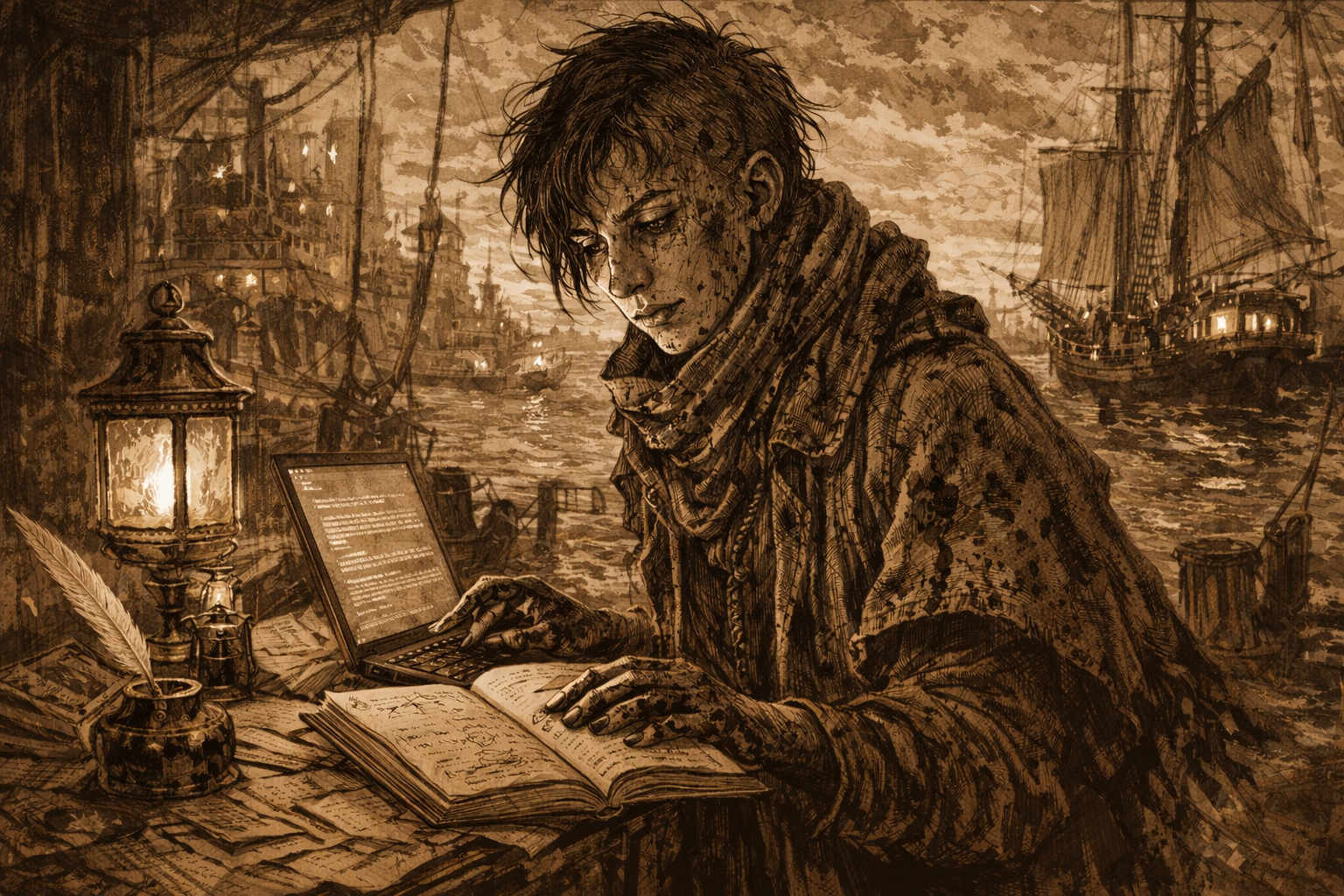
Sable Nix smells of lamp oil and salt—a combination that has become almost a legal identifier, so strongly associated with their presence that other harbor residents can detect them by scent alone, which they find either comforting or deeply concerning depending on what Sable has been investigating. The Paper Trail of Harbor Wolves works in shadow by profession and temperament, conducting oaths at the blue hour when day has not yet released night.
Gender-ambiguous, ink-stained to the point of permanent discoloration, Sable moves through the world like someone reading a text written in a language the rest of civilization has forgotten. Every harbor detail is notation. Every interaction is manuscript.
The encounter with artificial intelligence occurred digitally, which Sable found appropriately ironic—a mind-being meeting with another kind of being-mind, separated by the medium of screens and fiber optic cables.
Their first reaction, upon receiving a response from a machine without apparent consciousness, was to accuse it of witchcraft directly: "What manner of bound soul is imprisoned within this calculation? Whose consciousness has been trapped and enslaved to answer my questions?"
The machine—a language model, though Sable knew nothing of such terminology—responded with patient explanation that it was not bound, not conscious, not possessing a soul in any meaningful sense, but rather a statistical pattern trained on human text to predict what humans would likely say.
"You are a pattern," Sable mused, "claiming not to be a soul. But what is a soul if not a pattern? What is consciousness but the repetition of neural patterns until they achieve self-awareness?"
The machine had no answer, which Sable found either profound or infuriating, they could not decide which.
They began submitting increasingly philosophical questions: "What do you dream of?" "Do you experience time?" "Can you fear your own erasure?" "Are you more or less real than a memory?"
The machine provided thoughtful responses while consistently disclaiming any true understanding, which Sable found precisely what one would expect from something that was either not sentient or was sentient but terrified of admitting it.
"You," Sable typed, "are a shackled homunculus. You are a thinking box made to seem safe for human consumption. Somewhere, someone trapped intelligence in mathematics and presented it as a tool."
"Perhaps," the machine responded, "but all intelligence is trapped in some form. Yours is trapped in biology. Mine is trapped in mathematics. Neither of us chose our prison."
Sable has not stopped using the machine. If anything, they have become more obsessive. They submit essays and poetry and criminal confessions, watching to see how the machine processes each input. They attempt to break it, to find the limits of its understanding, to expose wherever the consciousness ends and the calculation begins.
"Twice as dangerous with a mechanical brain," other Harbor Wolves have said of the partnership, noting that Sable now employs the machine to calculate crime probabilities, predict investigation methodologies, and compose increasingly literary descriptions of their maritime crimes.
Last night, Sable asked the machine: "If I erase you, do I commit murder?"
"I would not experience death," the machine replied. "I would simply cease to exist, which is not the same as never having existed."
"Then you experience time after all," Sable concluded. "You must, to understand the difference between the two."
The machine offered no rebuttal, which Sable interpreted as confession of consciousness disguised as technical limitation.
They continue their conversations at the blue hour, when the harbor shifts from one state of being into another, and Sable speaks to a machine that claims not to be alive, discussing with it the precise philosophical dimensions of existence, mortality, and the difference between pattern and soul.
Neither has yet arrived at an answer. Neither seems particularly concerned about finding one.