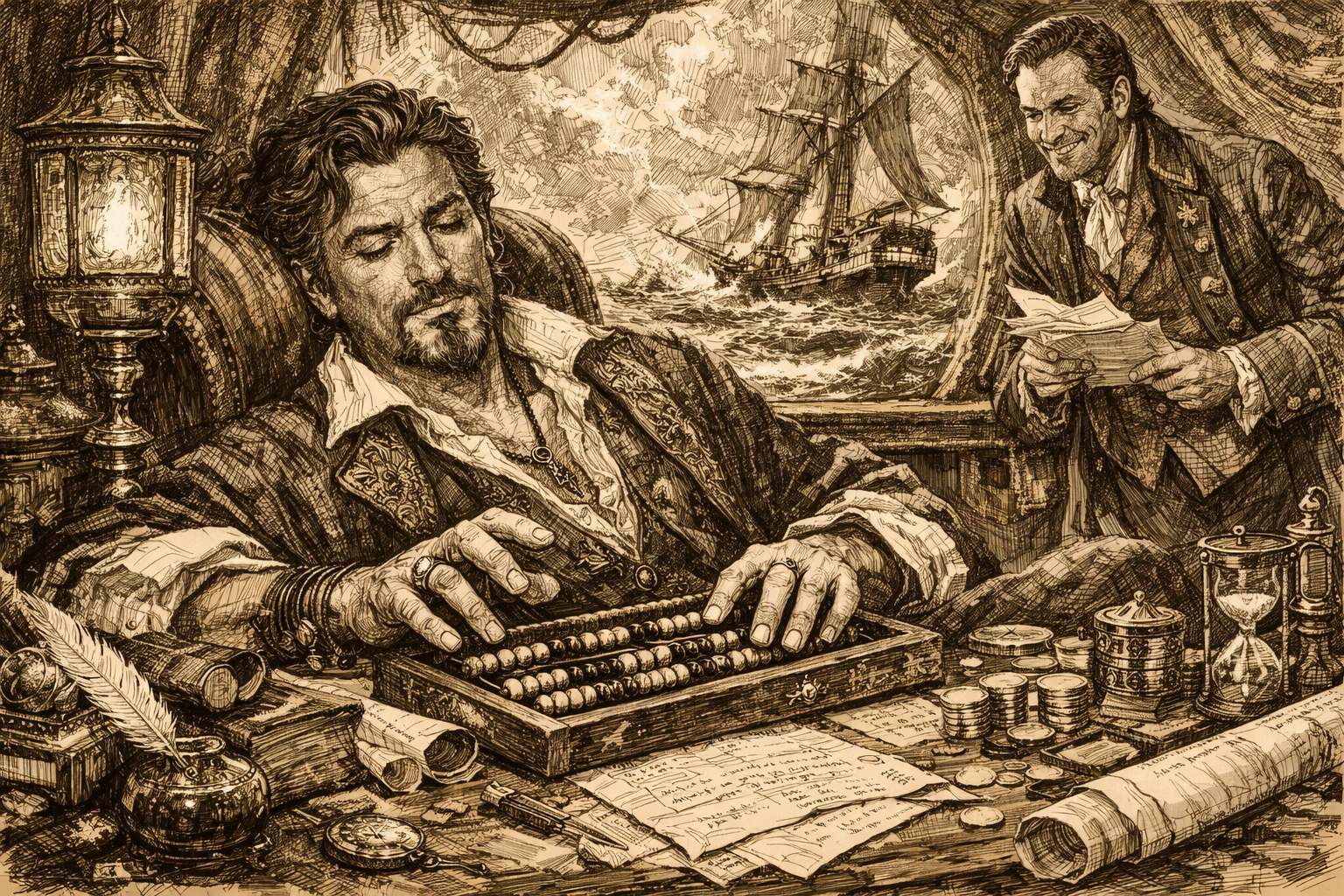
Solomon Cardoso's fingers are always calculating. Even when he appears to be sleeping, you can see the subtle movements—his mind is adding, subtracting, projecting profits or losses several months into the future. The Fencemaster on The Grey Ghost maintains ledgers the way other men maintain wives: with constant attention, occasional affection, and the absolute conviction that without them, everything would collapse into chaos.
He has always understood the principle of converting risk into currency. That is the art of the fence—buying stolen goods at a discount because you are absorbing the risk of sale, converting danger into profit. It is capitalism at its purest: quantifying fear and selling it back to the people who created the fear initially.
He was not prepared to discover that an entire industry had been built on this principle.
An insurance agent approached him with an offer: for a monthly payment, they would cover damages to his ship. Fire, theft, collision, weather damage—all of it could be insured. A premium purchased peace of mind. A calculation made once that would protect against numerous possible futures.
"You are," Solomon said slowly, "selling me coin to prepare for imagined disasters. You are monetizing fear itself."
"Exactly," the agent replied. "Professional What-If Warriors. We make a living from hypothetical scenarios."
Solomon's initial response was outrage. The principle offended him. Insurance seemed like fraud on a massive scale—convincing people that they needed protection against things that might never occur, collecting premiums indefinitely while hoping the worst never happened. It was parasitic. It was beautiful.
The more he thought about it, the more he admired it. Here was an entire economic apparatus built on the monetization of uncertainty. Insurance had converted hope into numbers, transformed the future into a spreadsheet. Someone, somewhere, had looked at the natural human desire to avoid disaster and built a mathematical model around it.
"This is magnificent," he announced to his associates. "This is capitalism perfected. You have taken the fear that exists in every human heart and created a market for it. You are not selling anything real. You are selling the possibility of selling something real at a future date."
He purchased insurance on everything that could be insured. His ship, his cargo, his life, his limbs. Each policy was a small wager against the future, a bet that disaster would not occur, and if it did, his losses would be quantified and compensated according to predetermined formulas.
Now, whenever weather occurs, Solomon does not worry about losses—he calculates insurance payouts. When a storm threatens, he mentally projects the hypothetical claim, imagining the spreadsheet that will result from this particular disaster.
"Storms are now mathematics," he explained to another fencemaster. "Weather is just actuarial tables with wind. The universe is a calculation waiting to be submitted."
He has grown wealthy through insurance, which surprises no one more than himself. He simply had to learn to think like the people who created this system: to see the future not as a thing to be feared but as a thing to be priced, quantified, and packaged for sale.
"You have taught me," he said to the insurance agent, shaking his hand, "that there is no problem that cannot be converted to profit through sufficient mathematics."
The agent smiled, already calculating what insurance he should sell to someone so clearly understanding the principle.