### The Brine Gate Chronicles: The Chicken Trick Scandal
_In which the Phantom of Brine Gate finds his feathers plucked by an ingenious scam, and the harbor holds its breath._
Ah, Brine Gate Harbor, that slippery ol’ eel of a place where history and mystery twine like the rigging on a ghost ship. Nestled uncomfortably between the past’s shanties and the present’s skyline, it is a realm where truth often dresses as fiction. I, Samuel Blackwater, your humble guide through this labyrinthine tale, offer you a scandal so rich, it sticks to your fingers like tar: the unraveling of the notorious Chicken Trick swindle.
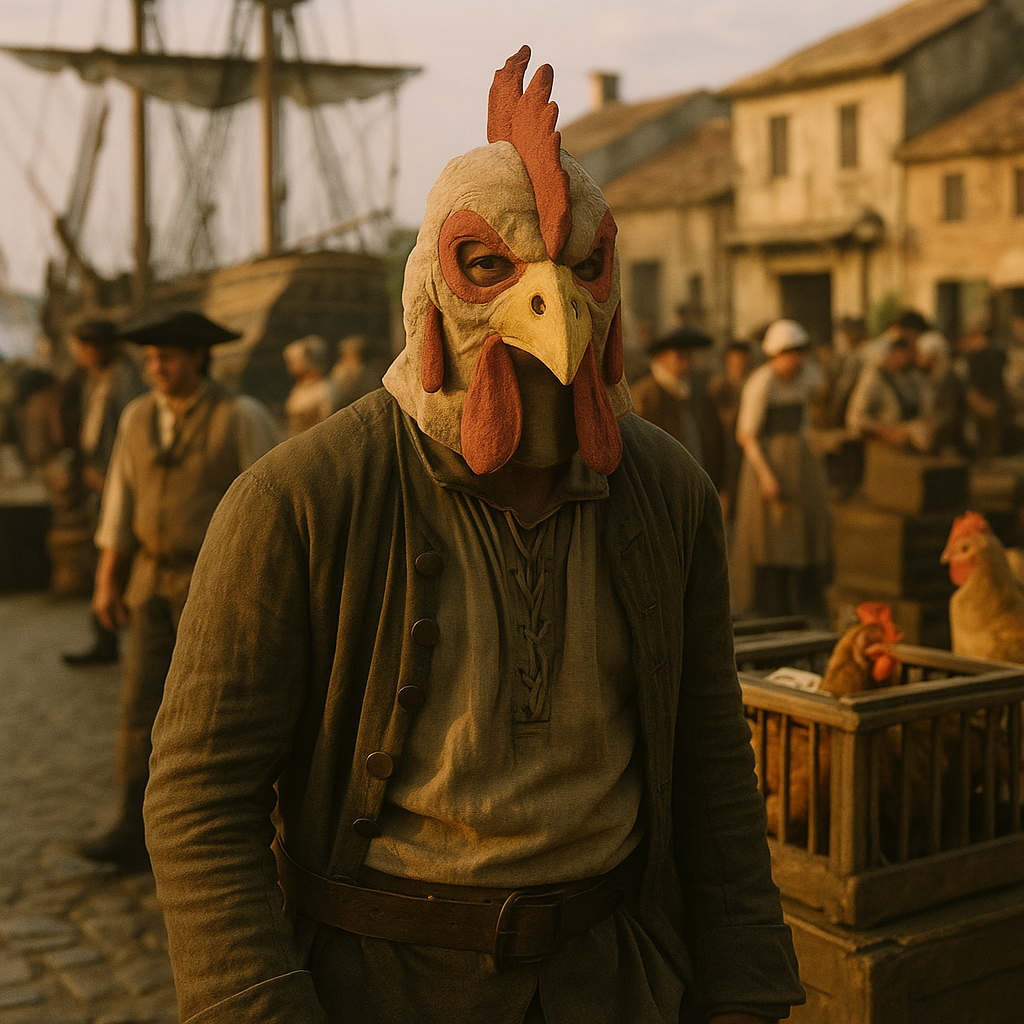
Enter “The Phantom” — known to his landlubber acquaintances as Alessandro Ferrante, though in this maelstrom of maritime misfits, only his alias carries weight. A man of salt and sinew, with a reputation greasier than a bilge rat’s tail, Ferrante is a mirage among men, here one moment, vanished the next. His heart, a pirate’s compass ever pointing to love or loot, has often led him astray, yet his cunning remained as sharp as a cutlass. No doubt influenced by that mentor of his, Eilidh Fraser — a lass known for using her tongue like a rapier (note: see “The Ash Tongue Incident,” Gazette, Vol. VI).
Ferrante, ever the opportunist, had hitched his fortunes to the most featherbrained scam this side of Blackbeard’s barnacles: the Chicken Trick. And what a ploy it was! A simple game born of superstition and bygone lunacy: bet on which chicken laid the golden egg first. Each Brinegater with more doubloons than sense would subscribe to multiple chances — after all, why risk one chicken when you could have a coop?
The plot thickened when the chickens — from reputedly mystical stock — began favoring a certain feathered felon, “Goldbeak,” named for the gilded tint of his beak. Bettors, drawn in as the gulls to a baitball, never suspected that “Goldbeak” had been fed a concoction of dyes and destiny, ensuring his eggs always glistened with fraudulent enchantment.
(Allusion: see Ovid’s Metamorphoses for further tales of transformation under dubious circumstances.)
But the ghostly hand of chance, or perhaps misfortune, tipped the scales. On the fateful day when the scam began to unwind, it was none other than Ferrante’s former lover, Stefano Timbro — “Ledger-Fingers” to his friends, “Pike” to his enemies — who noticed something amiss. Stefano’s keen eye, sharpened by intimate knowledge of Ferrante’s tricks (personal communication circa 1715; see “Tales of the Phantom,” Gazette, Vol. II), discerned the peculiar coloration in “Goldbeak’s” plumes.
Timbro, who had once whispered sweet nothings and now whispered betrayals, turned informer. Witnesses — some willing, others remunerated (see ledger extrapolation, Frestagon, C. Editorial Annotations) — noted Timbro’s accusations carried with “a voice that cut sharper than broken glass against a moonlit wave.”
The arrest was an affair as public as it was theatrical. Ferrante was apprehended mid-dockside, the clamor of the harbor arrested in the wake of his disgrace. Spectators cried foul, their cries echoing across the concrete that had once been mangrove thickets (a reminder: this bay looked different before the concrete, I assure you).
As Ferrante was led away, he muttered of “a long snake of lightning” that could drag the sun itself — a seeming confession to those who listened too closely, and a bafflement to modern ears. (Reference: the extension cord incident, Gazette, Vol. III, “The Phantom and the Lightning Snake.”)
Thus, dear reader, the Chicken Trick found its feathers clipped, and Ferrante’s journeys, for now, are stilled. Yet as my veritable editor, Cornelius Frestagon, would no doubt inscribe in his meticulous footnotes, _caveat emptor_: let the buyer beware, for in Brine Gate, reality seldom matches the registry.
And so it is that the Chicken Trick scandal joins the annals of Brine Gate’s storied lore, a saga of avarice and amorous entanglements, wherein truth wears a mask, and every echo hints at secrets untold. The harbor keeps its rhythm, the tide rolls on, and somewhere, perhaps, Ferrante schemes anew, waiting for his next opportunity to sail the unpredictable seas of fortune.
0 skulls
☼ Diversion
The Birth of Urbanicity
Dr. Frestes—Cornelius Frigon, as the pirates knew him—had a vision.
The old academic publication was dead. Its scholars had vanished. Its research had stopped. But the infrastructure remained....
Read the tale →