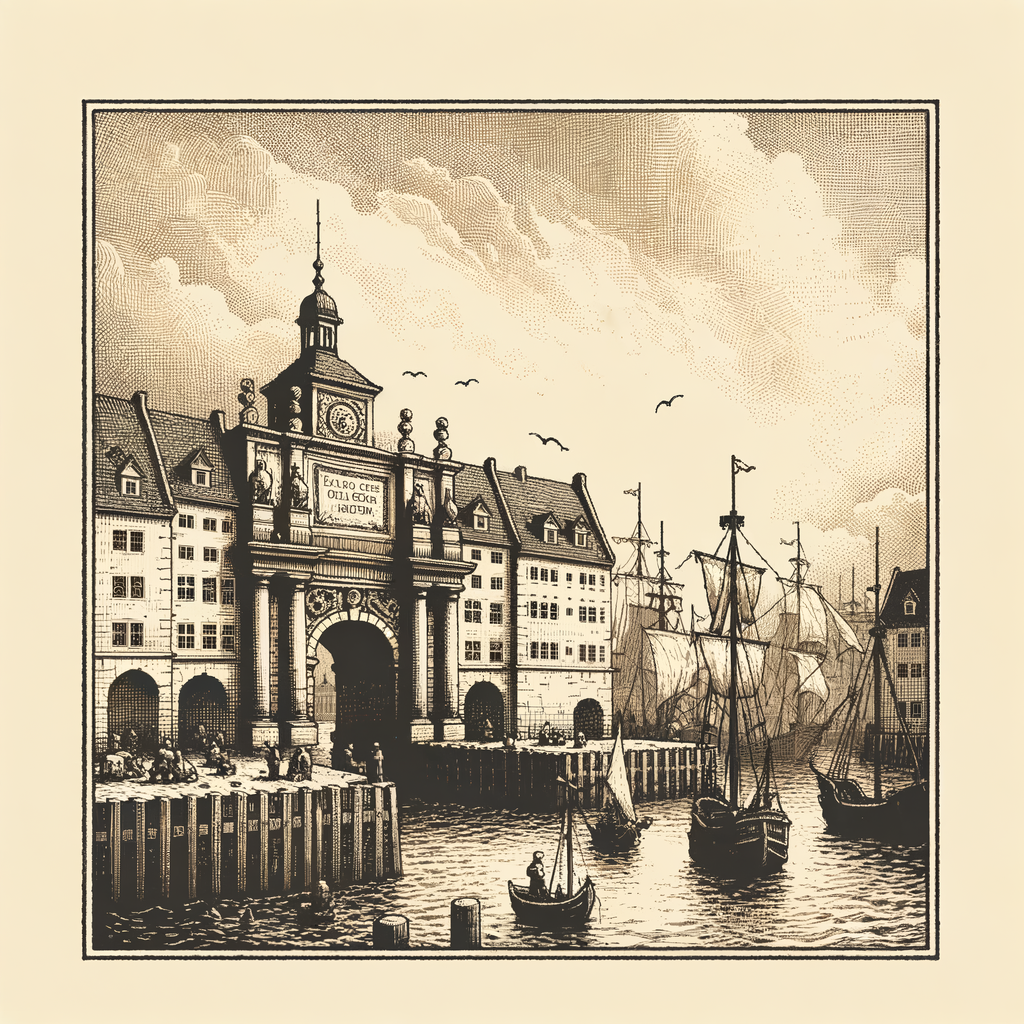
The harbor exists in the world the way a secret exists in the human heart: not quite real until spoken aloud, and then unmistakably there. Brine Gate Harbor sleeps at the mouth of the Salt-Fever River, where fresh water meets brine in a slow, grudging marriage. To reach it, one must navigate the Weeping Passage—a serpentine channel that winds through mangrove islands as if nature herself were reluctant to grant passage. The mangroves press close, their roots drinking from underground springs that seep upward, creating a constant dripping that echoes through the channel. In the ears of sailors, it sounds like weeping. In the ears of those seeking refuge, it sounds like welcome.
The geography of Brine Gate is its first and greatest defense. The river becomes a brackish lagoon, cradled in a natural bowl where the surrounding land rises in gentle swells. The approach from the open sea is almost impossible; the harbor is protected by the Shell Bar—a crescent shoal of crushed shell and coral that shifts with the tides, invisible at high water, exposed as treacherous shoals when the tide retreats. Beyond it lies Dead Man's Cant, a stretch of coast three miles to the east where an unpredictable current sets toward shore and wind dies in the doldrums with murderous regularity. Ships that venture there rarely return with all hands.
But the Weeping Passage, for those who know it, leads to sanctuary.
The earliest written mention of Brine Gate dates to 1562, when Spanish conquistadors established a mission on the banks of the lagoon. The mission, with its humble church and stone tower, was meant to convert the indigenous peoples and serve as a trading post for the colonial enterprise. The Spanish built well; they understood architecture as an instrument of dominion. The church tower still stands, though no longer for prayer.
In the night of March 15th, 1598, the ground beneath the mission trembled. The records from the colonial archives in Seville describe it simply: la tierra abrió y el agua tomó lo suyo—the earth opened and the water took what belonged to it. In a single night, the Spanish mission sank into the lagoon. Some accounts speak of an earthquake; others of a sudden subsidence of the coastal shelf. What matters is that the stone tower, perhaps by accident or by some graceful defiance of physics, did not sink entirely. It remains at the entrance to the Weeping Passage, leaning at a drunken angle as if perpetually startled by its own survival. Where a cross once crowned it, later hands mounted a compass rose—the first marker that Brine Gate Harbor had changed hands.
The Drowned Steeple, as it came to be known, became the harbor's guardian spirit and grim sentinel. Its stone is dark with age and salt spray. Its shadow falls across the Weeping Passage at certain hours, and sailors have long believed that to pass without offering it respect is to court disaster. Whether superstition or not, few vessels are ever lost in the passage itself.
For nearly a century after the Spanish collapse, Brine Gate Harbor existed in a state of beautiful vacancy. Indigenous peoples knew of it and kept their distance, respecting its haunted nature. Spanish colonial authorities, embarrassed by the loss, did not investigate further. Nature, meanwhile, completed its work, softening the broken stones of the mission and claiming the cleared land. Mangroves spread like fingers across the water. The brackish lagoon became a maze of channels and coves.
The first buccaneers to find Brine Gate arrived in the 1670s—desperate, hunted men whose names are now lost to everything except the oldest tavern songs. They came by accident rather than design; their ship, damaged in a hurricane and pursued by a Spanish frigate, fled into what seemed a dead end. The frigate turned back, unable to navigate the Weeping Passage. The buccaneers, realizing they had found something precious, did not immediately leave.
What they discovered was a harbor that was not only hidden but defensible. The natural bowl of the lagoon meant that any attack from the sea would be funneled through the Weeping Passage, where superior numbers meant nothing. The Shell Bar and Dead Man's Cant provided additional protection; no fleet could approach from the east. The elevation of the surrounding land allowed for observation of the open sea beyond. And crucially, the harbor was large enough to accommodate a fleet of significant size—dozens of ships could anchor safely in the lagoon's brackish waters.
It did not take long for others to follow. By 1690, Brine Gate Harbor had become what it would remain for the next three and a half centuries: a haven for those sailing outside the law.
The first structures were temporary, desperate things—canvas and salvaged timber, built with the assumption that the authorities would discover the harbor at any moment and destroy what had been made. But the authorities never came. The Spanish empire was in decline; the colonial administration was more concerned with defending established ports than hunting ghosts in hidden channels. Slowly, the temporary became permanent. The ramshackle became infrastructure.
Scupper Wharf was the first serious construction—a 200-foot pier of salvaged timber extending into the lagoon from the natural clearing on the western shore. It was built not by architects but by sailmakers, rope-workers, and carpenters who understood ships better than buildings. The wharf is functional rather than elegant, purposeful rather than beautiful. But it has endured, rebuilt and repaired a hundred times, each generation leaving their mark.
Near the wharf, the first permanent establishments took shape. The Careening Beaches—three stretches of firm sand where the slope of the shore allowed ships to be careened for repair—became subject to strict conventions. Too many vessels at once on the beaches could cause chaos; the early harbor masters developed a system of rotation and priority that would last centuries.
Inland from the waterfront, the harbor began to spread organically. Sailmakers and rope-workers built their lofts on pilings over the lagoon, connected by narrow catwalks and swaying rope bridges. This eventually became Ratline Row, a floating street where the continuous click-clack of looms and the hiss of tar could be heard from dawn until dusk. The workshops smelled of canvas, salt, and the peculiar sweetness of treated fiber.
Behind the shore, in a small valley away from the waterfront, the Powder House Hollow was excavated—stone magazines set into the hillside, where ammunition and gunpowder could be stored safely away from the main settlement. The harbor's inhabitants, having learned lessons from other pirate havens that had been destroyed by fires, took precautions.
By the turn of the eighteenth century, Brine Gate Harbor had evolved from a desperate hideaway into something more deliberate: a city built specifically for those who lived outside civilization. It had geography to protect it, infrastructure to sustain it, and a population committed to its secrecy.
The harbor had not yet become what it would be under Isabella Tidecrest and Samuel Blackwater, but its bones were sound. In the mangrove channels and the brackish lagoon, in the Drowned Steeple's patient vigil and the Shell Bar's shifting defenses, the foundations had been laid.
Brine Gate Harbor existed now as a question asked by the sea itself: what happens when the outcast find sanctuary? The answer would take three more centuries to fully form.