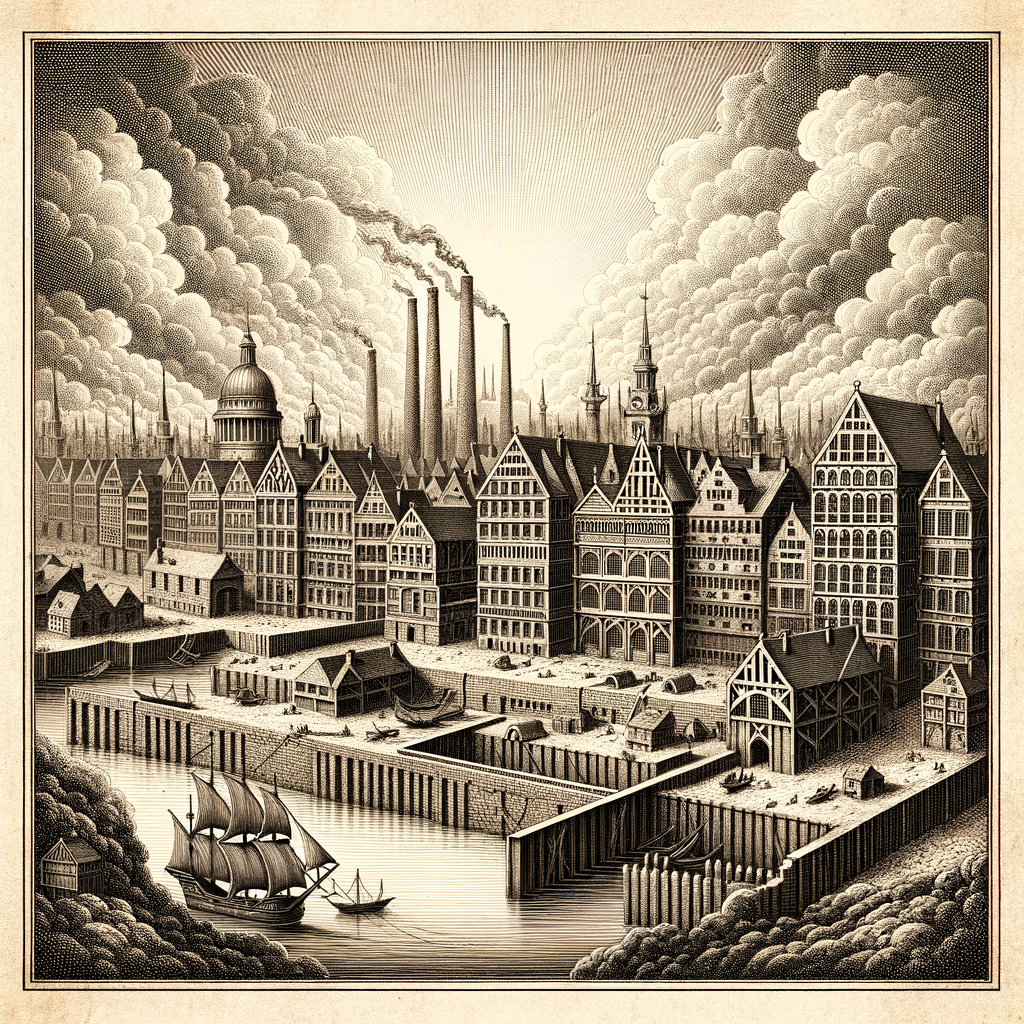
A city is not built by dreams alone; it is built by the deliberate arrangement of stone, timber, and intention. Brine Gate Harbor's architecture speaks not of imperial grandeur or merchant prosperity, but of something more essential: the physical embodiment of communal survival and democratic necessity. Every structure in the harbor was built to answer a specific problem, and in solving those problems, the harbor's inhabitants created something that would outlast empires.
The harbor that emerged over the eighteenth century was organized not around a central plaza or grand avenue, but around function and faction. Different zones served different purposes, each deliberately separated to prevent cascading disaster. If fire consumed the warehouses, it could not spread to the powder magazines. If disease broke out in Hammock Town, the main settlement was protected. If violence erupted on Gallows Jetty, The Broken Meridian could close its doors.
Scupper Wharf remained the primary landing, but as the population grew, secondary infrastructure became necessary. Gallows Jetty, a shorter pier extending from the northern shore, served multiple purposes. It was where ships could be loaded and unloaded when Scupper Wharf was crowded. But its name was not accidental. Gallows Jetty was also where justice—or what passed for justice in the harbor—was administered. Court martials were held there, sentencing passed, and occasionally executions carried out. More importantly, it was the traditional site where the Articles of Agreement were signed. Every ship operating from Brine Gate Harbor was bound by articles, a written code of conduct negotiated by the crew and formalizing the division of spoils. Gallows Jetty became the harbor's civic center, the place where law—even the law of pirates—was made visible and binding.
The Careening Beaches expanded as the harbor did. Three separate stretches of firm sand, each positioned to catch the tides and currents most favorably, allowed simultaneous repair of multiple vessels. But the beaches were not mere parking lots. Strict conventions governed their use. A ship undergoing major repairs could occupy a beach for weeks; minor repairs might take days. The schedules were negotiated and enforced with the kind of precision a city manager might bring to a port authority. The beaches were assigned by the harbor masters, and disputes about schedule were arbitrated not with violence but with reference to written records. Even in the earliest decades, Brine Gate Harbor was developing the bureaucratic mechanisms of civilization.
Ratline Row emerged as the harbor's economic engine. Sailmakers, rope-workers, and canvas merchants built their lofts on pilings driven deep into the lagoon's bottom. The walkways between them—narrow catwalks and swaying rope bridges—created a vertical economy. A ship needing new sails could walk between lofts, comparing work and price. The rope-walks where cordage was manufactured stretched for hundreds of feet, their looms audible from the water. The merchants who traded in supplies and materials gradually concentrated here, drawn by the concentration of ships and shipping-related activity.
Ratline Row was not planned by any single authority; it emerged from the accumulated decisions of individual craftsmen and merchants. Yet it followed a logic all cities follow—the logic of proximity and economic efficiency. People clustered where their skills could be most profitably employed. Suppliers positioned themselves near their customers. The result was a marketplace more efficient than many European cities of the era.
Inland from Ratline Row, a different kind of infrastructure took shape. The Counting House was built first—a fortified structure of heavy stone, positioned centrally and defensible. Its purpose was precise: to calculate shares and arbitrate disputes. When a ship returned from a successful voyage, its plunder was brought to the Counting House. There, trained accountants—many of them defectors from colonial treasuries—divided the spoils according to the articles governing that particular crew. A captain might take twelve shares; a skilled hand, two; a newcomer, one and a quarter. Every calculation was recorded in ledgers kept with meticulous care.
The Counting House was not merely a cashbox; it was a court. When disputes arose over shares, it was to the Counting House that grievances were brought. The head accountant, elected periodically by the harbor council, wielded considerable power—not through force but through the authority that comes from controlling information and maintaining fairness. To be cheated in the Counting House was rare; its reputation for accuracy was beyond question.
Adjacent to the Counting House stood The Fencemaster's Yard, a walled compound run by Solomon Cardoso, a former Spanish merchant whose pragmatic approach to commerce transcended national allegiance. The Fencemaster's Yard was where stolen goods were converted into legitimate profit. Cardoso and his staff managed the conversion of contraband into tradeable goods. They also functioned as informal bankers. A pirate could deposit his shares with the Fencemaster, and Cardoso would arrange for its investment or transfer to distant ports. The compound was fortified because its contents were valuable, but also because Cardoso had learned early that a merchant who dealt with pirates needed the appearance of security to maintain the confidence of both sides.
The Sick House stood at a remove from the main settlement, in the cooler air of the island's interior. Maritime life was hazardous; illness was constant. Scurvy, infection, and the fevers that swept through the lagoon required dedicated facilities. The Sick House was maintained by common contribution—every successful voyage added funds to its support. It was staffed by a rotating crew of those with medical knowledge, from experienced physicians to herbalists who understood the properties of tropical plants. The Sick House was never comfortable, but it was effective, and it established something crucial: the idea that collective welfare was worth investing in.
The Bone Orchard, the harbor's cemetery, lay on a rise to the south. At its center stood the Mast of Remembrance, an actual ship's mast salvaged from a wreck and driven vertically into the earth. Names were carved into it—those lost to the sea, to violence, to disease. The mast became a tradition; newly deceased were not fully honored until their names appeared on it. The Bone Orchard transformed the harbor from a temporary refuge into something permanent, something worth building for the future.
Blacktide's Tower dominated the harbor's high point—a stone watchtower originally built as a Spanish mission structure, now occupied by Jean "Blacktide" Marcheur, the harbor master. The tower served multiple functions. From its height, approaching vessels could be identified and monitored. Signals could be sent via flag or lantern to alert the settlement of danger. But the tower was also a symbol. It announced that Brine Gate Harbor had a government, however loosely structured, and that this government intended to persist.
The fortifications at Redoubt Cay, the low island that guarded the mouth of the Weeping Passage, demonstrated the harbor's willingness to meet force with force. The earthworks and stakes, reinforced with six 12-pound guns salvaged from a Spanish galleon, represented genuine naval power. A ship attempting to force the passage would face cannon fire from multiple angles. The guns could not be moved easily, but they did not need to be. They were permanent, planted in the earth as a statement of intent.
Hammock Town sprawled across the interior lowlands—a loose collection of temporary structures, hammocks strung between poles, canvas shelters, and ramshackle buildings where sailors between voyages could find shelter, provisions, and companionship. It was chaotic in appearance but organized in function. Different sections developed different characters: the workers' quarter where sailmakers and rope-workers lodged, the gamblers' warren where dice and cards never stopped moving, the quieter section where retired captains maintained small establishments. The town was rarely at rest; somewhere a fiddle was playing, somewhere someone was arguing, somewhere a fire burned for cooking.
But the true heart of the harbor, and the structure that most perfectly embodied its nature, was The Broken Meridian. This sprawling two-story establishment of ship's timbers and palm thatch sat at the junction of Scupper Wharf and Ratline Row, making it the geographic center of commerce and social life. Above its bar, a navigation instrument—a meridian circle—was mounted deliberately broken, its mechanisms smashed, its face fractured. The point was clear: in Brine Gate Harbor, normal rules of navigation did not apply. The compass that guided human behavior was not the magnetic compass but something else entirely.
The Broken Meridian was neutral ground. Feuding captains could meet there without fear of violence; the establishment's reputation for impartiality was absolute. Behind its unmarked door lay The Chart Room, accessible by invitation only, where the harbor's true councils met.
All of this infrastructure reflected a single principle: that a city of outlaws required the same civic institutions as any other city. Democracy, efficiency, fairness, and common defense were not luxuries that pirates could afford to ignore. They were necessities.
Brine Gate Harbor's architecture was the architecture of survival through organization. Every structure told the story of a community learning to govern itself. The harbor was built not by a single visionary but by the accumulated practical wisdom of merchants, sailors, soldiers, and dreamers who understood that the only cities that last are the cities that learn.