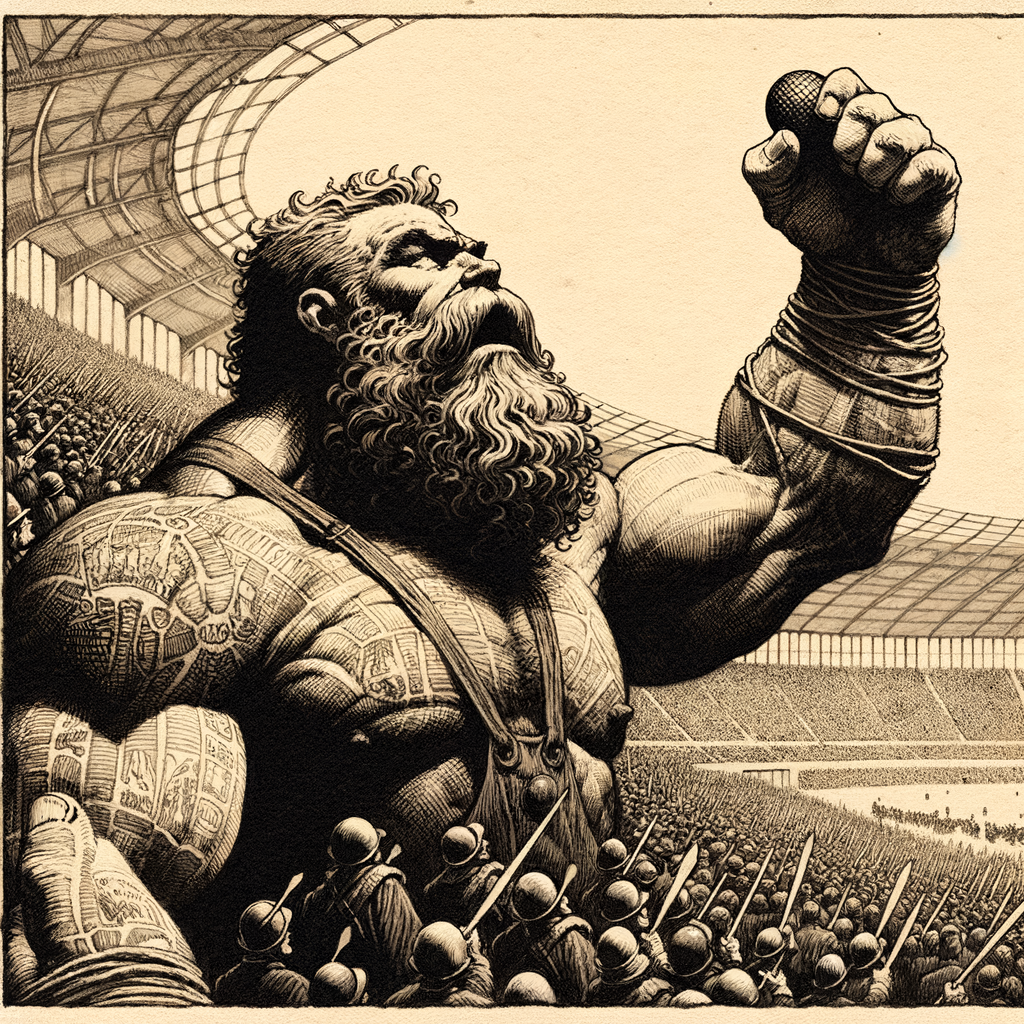
Brendan McCarthy's teeth are filed to shine like iron—a modification he undertook both aesthetically and practically, as he discovered early in his pirating career that teeth sharpened to metal-like points can bite through chain and cause considerable psychological distress in targets. The Iron Maw of Harbor Wolves, now stationed at Prison Docks, has always appreciated the intersection of function and terrifying imagery.
He was entirely unprepared for what he terms "Stadium Sorcery."
A colleague suggested he attend a modern sporting event—specifically, a soccer match, though Brendan initially heard "sorcery match" and was considerably disappointed to discover it involved an actual ball rather than any discernible magic. He attended primarily to observe the mass coordination of the crowd, suspecting it was either a cult or military rehearsal, possibly both.
The experience exceeded his expectations for organized chaos.
Thousands of people arrived wearing the same colors. They painted their faces in matching patterns. They performed synchronized chanting that began at one point of the stadium and rippled through the crowd like a wave deliberately trained to attack. When "their" team scored, the coordinated response was immediate: roaring, jumping, the ritualistic execution of previously practiced physical movements, all perfectly synchronized.
"This," Brendan whispered to his companion, "is an invasion force. This is how they condition them."
He observed the phenomenon with increasing fascination and mounting alarm. Strangers coordinated through shared symbols and sounds. Money was exchanged for the privilege of participating in this mass experience. The leaders—the athletes—performed increasingly dramatic actions while the crowd responded predictably to stimulus, suggesting either that free will was an illusion or that modern society had perfected behavioral conditioning.
The coordinated chanting disturbed him most profoundly. In his experience, chanting preceded violence. Chanting meant synchronized action, which meant individual judgment was suspended in favor of collective movement. He had used similar techniques with his own crews, achieving excellent results in raids and tactical operations.
"They have weaponized brotherhood," he declared when the match concluded and the crowd dispersed. "They have turned the human desire for belonging into a training mechanism for coordinated action. Give them weapons and they would function perfectly as military unit. No individual choice. No dissent. Pure synchronized response to stimulus."
He attended three more matches over the following weeks, each time more convinced of his assessment. The slogans were printed on clothing, turning the participants into unwitting advertisement for their own conditioning. The rituals were repeated identically each week, creating neural pathways of habitual response. The entire apparatus seemed designed to identify which humans could be most thoroughly coordinated and which would naturally resist.
"It's just sports," someone told him.
"Exactly," Brendan replied, his iron teeth gleaming. "That's the genius of it. They call it entertainment while they rebuild society along lines of perfect coordination. I respect it. I may fear it. But I respect it."
He now attends matches obsessively, studying the methodology. He has even begun analyzing crowd response patterns, attempting to predict which sections will chant when and with what intensity. He suspects he could eventually organize this apparatus into something genuinely dangerous, which both excites and horrifies him.