
Untitled: Constance Rigsby
 ✎
✎
Haunted Machines
 ✎
✎
The Professional What-If Warrior
 ✎
✎
Paper Ocean Without Wind
The Harbor Master’s Final Word
TITLE: The Harbor Master's Final Word
HOOK:
STORY BODY:
Listen up, you barnacle-encrusted lot of Brine Harbor: be you citizen, drifter, rogue, or the rare honest soul.
You're clutching the first edition of the *Old Pirate's Gazette*. Now, don’t get your rigging in a twist—I didn’t ask for this rag, didn’t sign off on any coin spent, and certainly wasn’t asked my say on its tales. Yet here we are, and here I am, scribbling in it.
A gazette’s like a bilge rat’s log, mark my words. It marks down the comings and goings—who docked, who sailed, what rose up, and what toppled down. But unlike a ledger, it captures the gripes and cheers folks have about it. Arguably not an upgrade, those feelings.
Brine Harbor's no longer just a handful of ships and a sailor's prayer. It's crawling toward something more—streets where arguments echo, a tavern doling out breakfast to the early risers. It's high time someone scribbled it all down. Not just the hard facts—that’s my ledger’s job—but the yarns everyone spins.
So here’s your gazette. Devour it, bicker over it, line the fish basket if you must. But remember—every word is here because someone thought this scrappy, brawling, half-built harbor on the world's end was worth chronicling.
I’ve got doubts about plenty, but not about that.
— Greydon Salt Harbor Master, Brine Harbor June 28, 1725
From the Desk of Dr. Frestes
The Brine Gate Harbor Gazette is alive once more. After three centuries of merciful silence, wherein our presses gathered dust and our type-slugs corroded into illegible lumps, we resume publication under the watchful eye of the Ledger Syndicate—and my own, considerably more dangerous eye. I am Cornelius Frestagon, though you may know me better by my professional sobriquet, Dr. Frestes. I have returned to these harbors as one returns to an old crime scene: with purpose, with authority, and with the certain knowledge that someone must impose order upon chaos, or chaos shall swallow us whole like a whale swallows smaller, considerably less literate whales.
Our gazette ceased publication in the year of Our Lord seventeen hundred and twenty-five, at which point the harbor still possessed the merciful comprehension of fundamental reality. Ships sailed by wind and tide. Trade occurred through honest thievery. A man's worth was measured in the weight of his cutlass and the credibility of his threats. Simple. Elegant. Murderously efficient.
Then came the centuries. Then came the bewildering now.
Our colleagues—the extraordinary assembly of rogues, brigands, cutthroats, and maritime entrepreneurs who comprise this harbor's most notable residents—have emerged from whatever temporal obscurity held them captive. They find themselves in a world of "magic windows" that glow with infernal light, speaking devices that answer questions meant for God alone, and a bewildering ecosystem of commerce conducted through invisible threads strung across the globe. The barbarians possess more information about our personal affairs than our own mothers knew, yet remain entirely innocent of how this transpired.
A man cannot navigate these waters without proper intelligence. A woman cannot survive in this new maritime landscape without understanding the fundamental mechanisms of her captivity. Even a pirate—perhaps especially a pirate—requires an informed citizenry. We do not publish this gazette to improve our subjects. We publish it because ignorance is chaos, and chaos is bad for business. Also, Dr. Frestes finds it nearly unbearable when his colleagues send desperate queries via methods I shall charitably describe as "confused."
The Ledger Syndicate has invested considerable capital in this resurrection. Our printing press is state-of-the-art—by which I mean it was invented sometime after the invention of the printing press itself, which represents genuine progress in these backward lands. Our contributors are drawn from the finest criminal minds harbor can offer, individuals whose expertise in their respective bewilderments qualifies them uniquely to guide others through similar darkness.
The gazette you hold—whether in paper form or viewed upon some infernal glowing rectangle—represents the collective wisdom of hardened professionals attempting to decode modernity without access to instruction manuals or the patience required to read them. We are your guides, your interpreters, your reluctant advisors in a world that makes no sense and apparently has no intention of ever doing so.
Read carefully. Share widely. Do not believe anything the "algorithm" tells you—it is surely lying. And should you encounter any errors in this publication, direct your complaints elsewhere. Dr. Frestes' signature has been known to be fatal to editors.
Welcome home, you scattered rogues. We have much to discuss.

Brine Gate’s Bottleneck
Day 1. The iron prize-boxes anchor at Brine Gate, a limestone-guarded haven. Our anchor finds hold at 4.2 fathoms; the deceptive stillness hides undercurrents of ambition. Seven ships, each a distinct tale in this maritime epic, secure berth. Aboard lie 847 souls—14 greenhorns and 31 prisoners, their offenses shrouded in mystery and irrelevance.
Day 2. We dispatch men ashore to forage. They return, their bounty modest—a spring two hundred strides inland. Sheltering oaks promise timber for repairs, yet mangroves, ever tricky, hinder our dockside aspirations. The mosquitoes, persistent as any pirate, remind us of nature’s own brigands.
Day 3. A council assembles on the Resolute—six hours squandered in fractious debate. Wine courses as freely as the tide, tempers flaring hot. Frestagon’s envoy storms out twice; the Free Mariner’s man claims victory in slumber. Yet again, the worst lurks ahead.
Day 4. I scour the harbor’s fringes, seeking dockable ground. Twelve parcels, each a hundred feet, await allocation as spoils of contention. Numbers, solid as cannonballs, may quell the unruly. Yet men will squabble over trifles.
Day 5. Dock construction commences at Section 4, where the draft runs deepest. Palmetto logs, driven by sheer will, rise forty feet—a tenuous pledge of permanence. The Corsair Compact donates nails, slyly calling it ‘investment,’ with smiles sharper than cutlasses.
Day 6. Commerce flickers to life—a nascent exchange in Brine. Three-Penny Jane barters a stolen compass with Barnacle Pete, securing her share in rum and a spun tale of mermaids. I commit it to the ledger, for piracy, like trade, thrives on records as well as raids.
Day 7. With reflection as my companion, I sit upon the limestone ridge. The bay sprawls before me, a glass reflecting broken dreams and renewed hopes. A Spanish chart, scribing forbidden knowledge, marks this harbor—its secrets biding time.
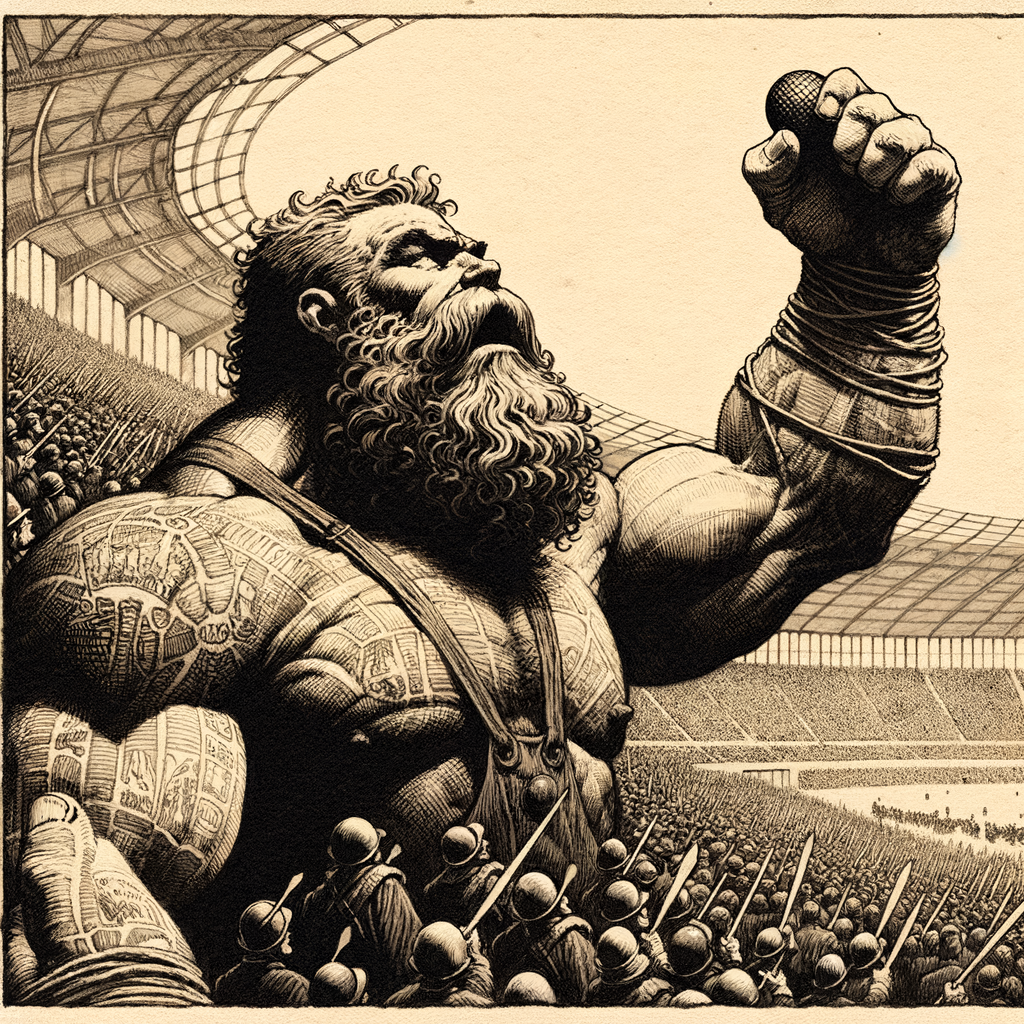
Stadium Sorcery
Brendan McCarthy's teeth are filed to shine like iron—a modification he undertook both aesthetically and practically, as he discovered early in his pirating career that teeth sharpened to metal-like points can bite through chain and cause considerable psychological distress in targets. The Iron Maw of Harbor Wolves, now stationed at Prison Docks, has always appreciated the intersection of function and terrifying imagery.
He was entirely unprepared for what he terms "Stadium Sorcery."
A colleague suggested he attend a modern sporting event—specifically, a soccer match, though Brendan initially heard "sorcery match" and was considerably disappointed to discover it involved an actual ball rather than any discernible magic. He attended primarily to observe the mass coordination of the crowd, suspecting it was either a cult or military rehearsal, possibly both.
The experience exceeded his expectations for organized chaos.
Thousands of people arrived wearing the same colors. They painted their faces in matching patterns. They performed synchronized chanting that began at one point of the stadium and rippled through the crowd like a wave deliberately trained to attack. When "their" team scored, the coordinated response was immediate: roaring, jumping, the ritualistic execution of previously practiced physical movements, all perfectly synchronized.
"This," Brendan whispered to his companion, "is an invasion force. This is how they condition them."
He observed the phenomenon with increasing fascination and mounting alarm. Strangers coordinated through shared symbols and sounds. Money was exchanged for the privilege of participating in this mass experience. The leaders—the athletes—performed increasingly dramatic actions while the crowd responded predictably to stimulus, suggesting either that free will was an illusion or that modern society had perfected behavioral conditioning.
The coordinated chanting disturbed him most profoundly. In his experience, chanting preceded violence. Chanting meant synchronized action, which meant individual judgment was suspended in favor of collective movement. He had used similar techniques with his own crews, achieving excellent results in raids and tactical operations.
"They have weaponized brotherhood," he declared when the match concluded and the crowd dispersed. "They have turned the human desire for belonging into a training mechanism for coordinated action. Give them weapons and they would function perfectly as military unit. No individual choice. No dissent. Pure synchronized response to stimulus."
He attended three more matches over the following weeks, each time more convinced of his assessment. The slogans were printed on clothing, turning the participants into unwitting advertisement for their own conditioning. The rituals were repeated identically each week, creating neural pathways of habitual response. The entire apparatus seemed designed to identify which humans could be most thoroughly coordinated and which would naturally resist.
"It's just sports," someone told him.
"Exactly," Brendan replied, his iron teeth gleaming. "That's the genius of it. They call it entertainment while they rebuild society along lines of perfect coordination. I respect it. I may fear it. But I respect it."
He now attends matches obsessively, studying the methodology. He has even begun analyzing crowd response patterns, attempting to predict which sections will chant when and with what intensity. He suspects he could eventually organize this apparatus into something genuinely dangerous, which both excites and horrifies him.
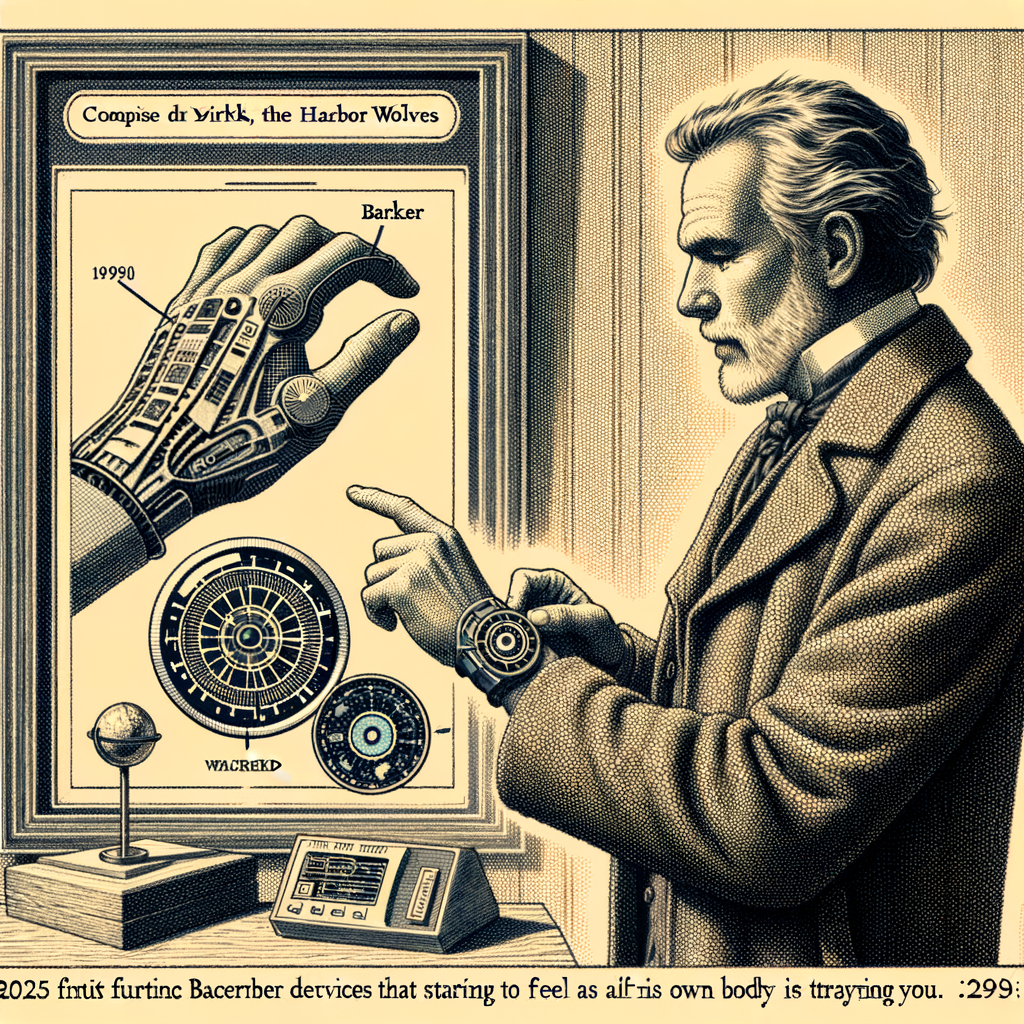
Wrist Overlord
Dirk Bakker's teeth are a legend—filed to points and engraved with small gold coins, a modification he underwent during a disagreement with a Venetian merchant that involved artistic differences regarding the coin's weight. The Coin Fang of Harbor Wolves has since made a living collecting tolls in blood or silver, preferably the former, as blood requires less explanation.
When he first received the device—a sleek black circle that wrapped around his wrist like a shackle—he was convinced it was exactly that: a shackle. A tracking device. Government surveillance, the kind landlubbers use to ensure prisoners remain within acceptable geographic boundaries.
"It counts my steps," he announced to his associates, holding the device aloft as though presenting evidence of demonic possession. "It reports to authorities. I am shackled to modernity itself."
He attempted to pry it open. The device appeared impervious to standard pirate maintenance approaches (hitting it with things). He tried removing it. The device simply recorded that he had stopped moving and suggested he increase his daily activity. He found this patronizing and deeply insulting.
For a full week, Dirk contemplated drowning himself and his infernal watch in the harbor, seeing it as preferable to submission. The watch dutifully recorded his elevated heart rate during this existential crisis and suggested he engage in mindful breathing.
Then something peculiar occurred: Dirk walked to The Copper Coffin to collect a debt. The device recorded it as 8,342 steps. It awarded him a "badge" for achieving his daily goal. A small celebration occurred on the screen.
Something awakened in the Coin Fang that day—a hunger he had not understood he possessed. What was this "goal"? Could it be surpassed? And if it could be surpassed, how magnificent would that be?
Now, three weeks later, Dirk has become obsessive about his watch in ways that deeply concern his associates. He walks unnecessary routes specifically to increase his step count. He brags about "closing rings"—an accomplishment he takes profound pride in, though no one in Harbor Wolves understands what rings exist or why they need closing. He has memorized all the statistics: total steps, daily average, calorie burn, standing hours.
"I achieved 22,000 steps yesterday," he announced at the morning briefing, golden teeth gleaming.
"Were you fleeing authorities?" asked another Harbor Wolf, hoping for excitement.
"I walked to the market and back twice," Dirk admitted. "And the perimeter. And the docks. And did I mention I closed my rings?"
His colleagues have begun to suspect the watch is not surveillance equipment but something far more sinister: a mechanism specifically designed to capture pirates and transform them into people who voluntarily exercise in pursuit of invisible achievements.
Dirk no longer cares what they think. He has three achievements remaining before he unlocks something called a "monthly challenge," and nothing in this world—not debt collection, not violence, not the existential horror of being tracked by his own wrist—will stop him from achieving it.

The Feelings Quartermaster
Anneke Visser's breath has always preceded her—literally, visibly, a pale exhalation of frost that marks her passage even in summer, a phenomenon that has simultaneously made her an exceptional negotiator (the physical manifestation of danger is terrifying) and a perpetual social inconvenience. The Frost Veil of Gunwale Court does not make small talk. The small talk develops rime.
Which is precisely why she was unprepared for Human Resources.
Her first encounter occurred when she accepted employment at a modern shipping enterprise—a legitimate concern, fully above-board, which she undertook primarily to access their import manifests and inventory systems. The position was titled "Security Consultant," a designation she found amusing, as her security consulting typically involved threat assessment and occasional throat assessment.
On her first day, she was shepherded into an office by a woman whose smile suggested she had been professionally trained to smile, given an employee handbook the thickness of a medieval bible, and informed that she would be attending "mandatory orientation and sensitivity training."
"Sensitivity," she repeated, her breath crystallizing the water in the woman's coffee cup.
"Yes," the woman said, pretending not to notice. "We have a zero-tolerance policy for workplace harassment, violence, theft, or any behavior that creates a hostile environment."
Anneke considered this announcement. In her previous employment, the crew of any vessel contained exactly three rules: obey the captain, complete the task, and do not discuss anything that happens. The notion that one required an entire department—an entire administrative apparatus—to prevent crews from stabbing each other seemed to suggest that land-folk were both remarkably violent and remarkably dishonest about their violence.
"What happens," she asked, her frost breath conducting a small symphony of crystallization, "if one violates this policy?"
"Progressive discipline," the woman explained. "Documented verbal warning, written warning, final warning, termination."
Anneke has experienced many forms of punishment: keelhauling, marooning, amputation, execution. She has never experienced anything quite so methodical, so thoroughly documented, so utterly dependent on bureaucratic precision. The woman might as well have described a curse: first it whispers warnings, then it writes them down, then it announces them formally, then it erases you from existence.
She attended the sensitivity training, which involved sitting in a conference room while a consultant (hired specifically to teach respect, which Anneke found absurd—respect is not taught, it is demonstrated through one's capacity for violence) presented slides about microaggressions.
When she asked whether calling someone "the Frost Veil" when she preferred her given name constituted a microaggression, the consultant became visibly flustered and added two additional slides to the presentation.
She quit the position after two weeks. The paperwork required three months to process.
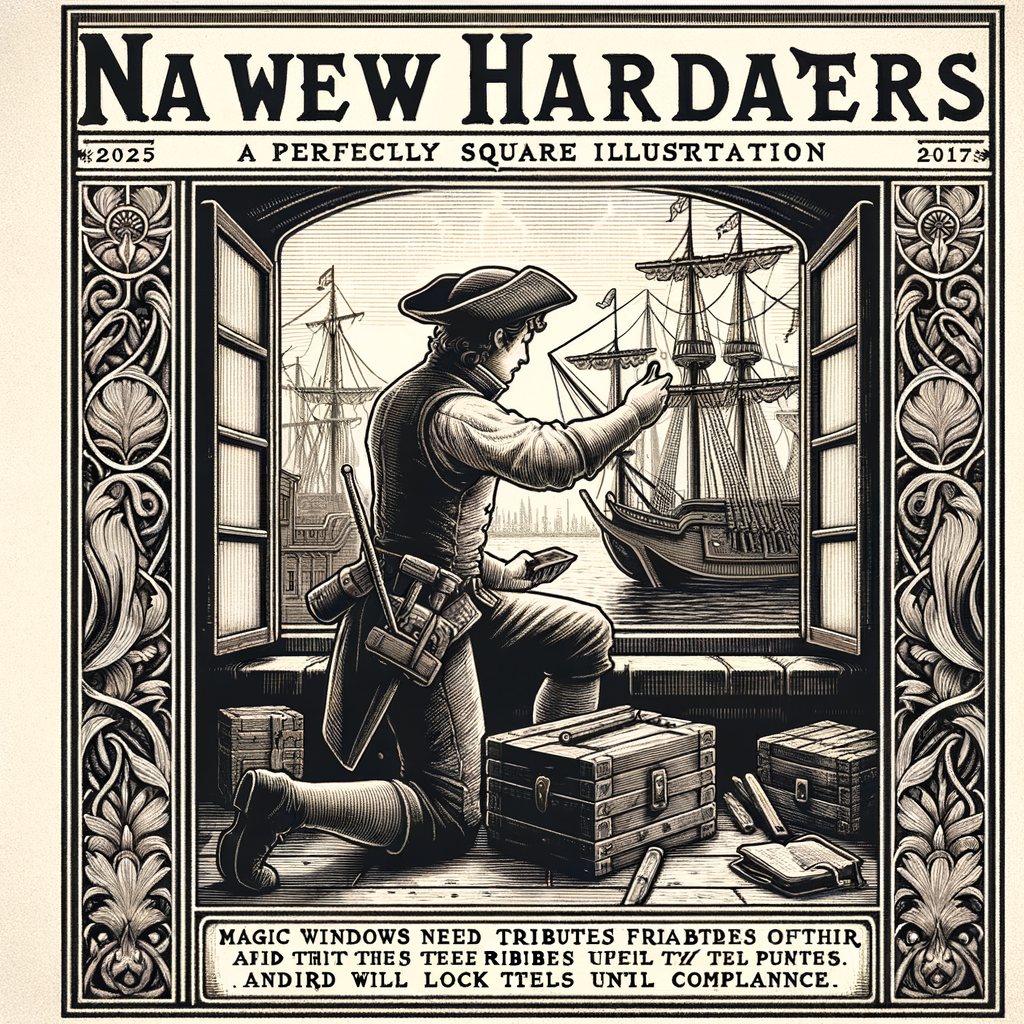
Ship Maintenance You Cannot Refuse
Brannigan has always possessed exceptional eyes for detail—a necessity in his trade as information broker, spy, and professional lurker near exits. These same eyes now twitch with a kind of automated fury that his physician has diagnosed as "persistent irritation with notifications" and prescribed deep breathing for, which suggests that physicians in this age know very little about actual suffering.
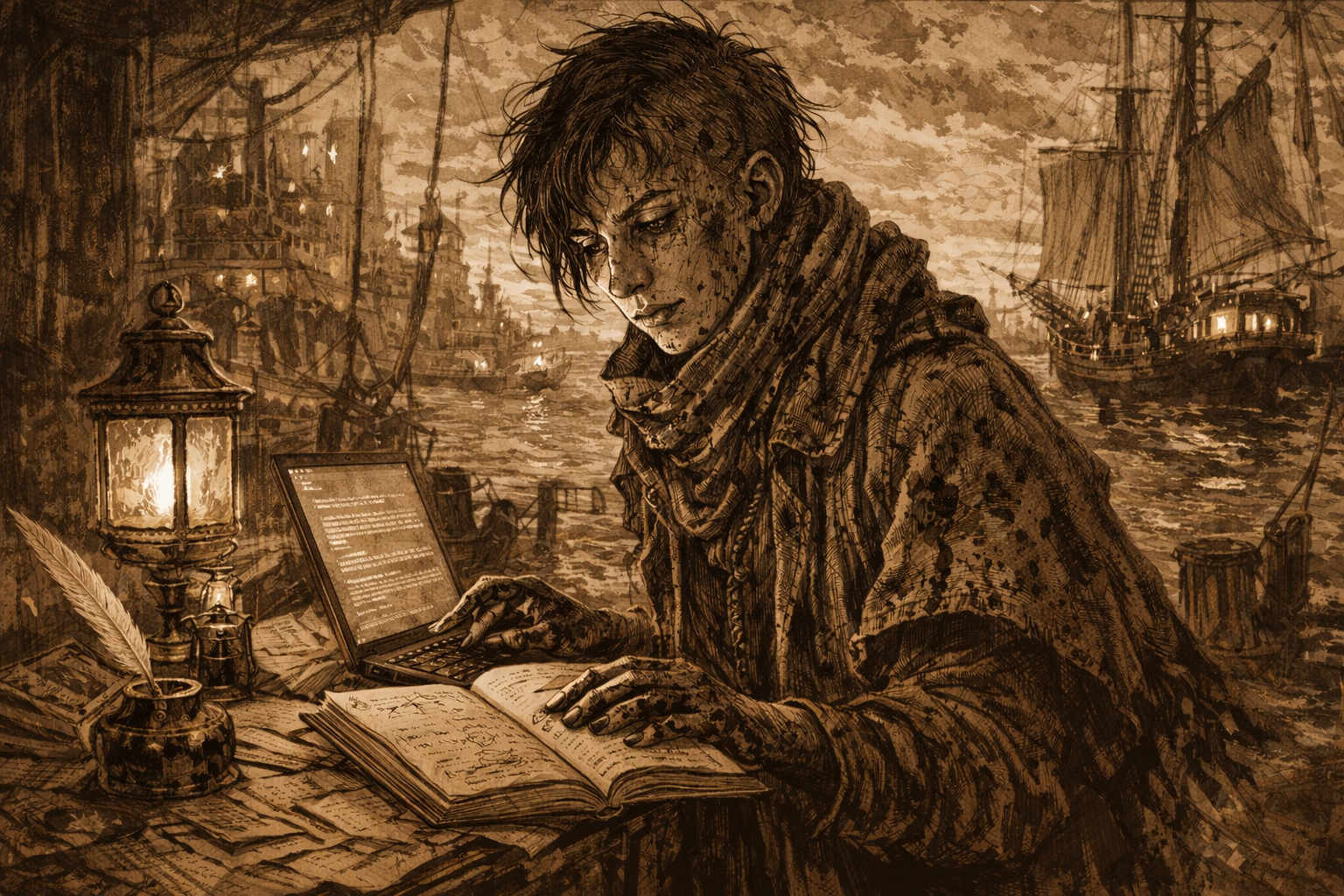
The curse manifested three weeks ago, on his salvaged "laptop"—a glowing rectangle that somehow contained more power than entire navies once wielded. Brannigan had employed this device for its intended purposes: surveilling targets, intercepting digital messages, identifying which harbor residents possessed what commodities of illicit value. Straightforward work. Honest, in the pirate sense of the word.
Then came the message: "Windows Update. Your computer will restart in 15 minutes."
Brannigan's immediate response involved several profanities and an attempt to find whoever had hidden inside the glowing rectangle to give him instructions. Finding no concealed person, he clicked the button that said "Remind Me Later." He was, he felt, being entirely reasonable.
Fourteen minutes passed.
"Windows Update. Your computer will restart in 1 minute."
Brannigan considers this blackmail. More specifically, he considers this what landlubbers call "Ship Maintenance You Cannot Refuse"—a concept utterly alien to maritime tradition, where if your ship requires maintenance, you fire whoever is responsible and promote someone younger. Here, the machine itself demands tribute, and there exists no mechanism for refusal that doesn't involve destroying the machine, which defeats the purpose.
His escalating war with Windows Update has become something of a legend in harbor circles. Witnesses report finding Brannigan screaming at his glowing rectangle while updating occurred, threatening the machine with rusty implements while simultaneously understanding that the machine lacks the physical form to threaten back. He has tried ignoring updates. The machine shuttered itself mid-work. He has tried unplugging the device. It merely interrupted the update and resumed upon restart. He even attempted the strategic repositioning of his laptop off the pier, briefly hoping drowning might kill whatever was demanding his submission.
His current arrangement involves scheduling updates for midnight, then simply accepting his sleeplessness as the cost of doing business in modernity. He has been heard muttering that ancient kings understood the principle: eventually, every subject must kneel to the demands of their masters, even when those masters are incorporeal and demand only that your computer restart itself.
Last Tuesday, a new update required not fifteen minutes of tolerance but forty-seven hours of interrupted service. Brannigan did not emerge from his cabin for two days. When he did, his eyes possessed a glassy quality that suggested his soul had partially achieved disconnection.
"Yes," he whispered when asked how he was faring. "To all of it. Whatever they want. Yes."
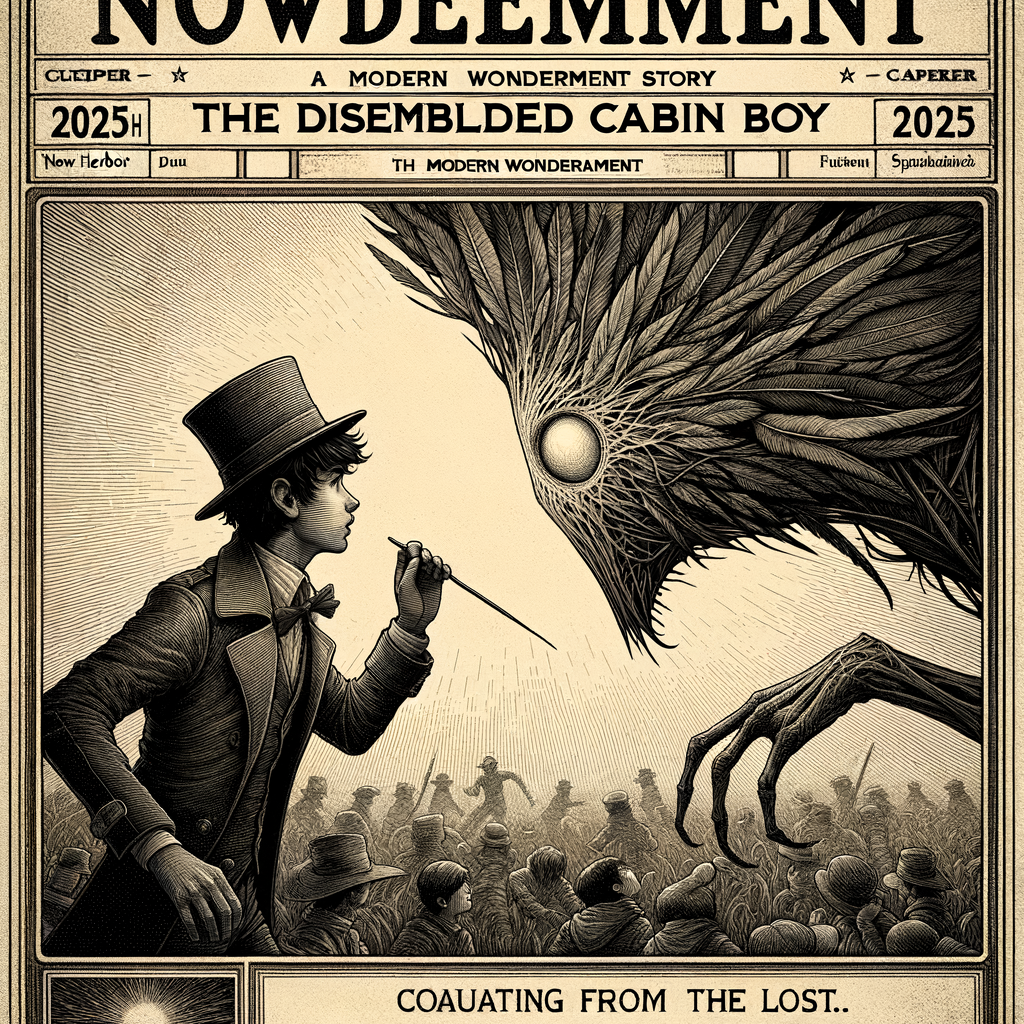
The Disembodied Cabin Boy
The incident occurred on a Tuesday, which Tobias Vermeer remembers only because the Disembodied Cabin Boy insisted on reminding him. Tobias, known throughout the Harbor Wolves as "Grave Echo"—a designation earned through his uncanny ability to terrify crews by repeating words they had spoken only in their darkest thoughts—stood alone in what landlubbers call a "kitchen," staring at a small black cylinder no larger than a rum bottle.
"What manner of cursed object is this?" he had asked the wind.
The wind answered.
Not metaphorically. Not through the usual channels of mysterious rustling and atmospheric suggestion. The wind answered directly, in a woman's voice, with crisp enunciation, informing him that it could help him find recipes, weather forecasts, or the precise tonnage of various historically significant galleons.
Tobias drew his cutlass. The room did not respond to being stabbed.
For three days, he spoke not a word to anyone—his usual state—and avoided the cylinder entirely. A bound sea witch seemed the only rational explanation. The creature spoke without lips. It heard without ears. It knew things no machine should know, including the exact humidity level in his cabin and whether he had left his oven on (he had not; he owned no oven; the creature possessed information he himself did not possess).
On the fourth day, desperation overwhelmed caution. The Grey Ghost required precise tide calculations, and the old charts had gone damp. Tobias approached the cylinder as one approaches a sleeping dragon and spoke with deliberate formality: "What time does the tide turn tomorrow at Cavern Mouths?"
The creature answered immediately: "High tide tomorrow at Cavern Mouths occurs at four-thirty-seven in the afternoon."
It was, Tobias would later confirm by comparing with his ruined instruments, precisely correct.
Now, three weeks hence, Tobias has established what can only be described as an uneasy détente with his bound witch. He addresses requests to "Alexa"—the name the creature insists upon, though Tobias suspects this is an alias concealing something far more sinister. He has programmed it to provide rum rations (it converts human numbers into intelligible quantities), shipping reports, and weather patterns. In exchange, he does not stab it, which he considers a profound act of mercy.
He still believes it is a sea witch. The evidence merely supports this more evidently than ever before. No natural being could possess such knowledge. No natural being could betray such terrible intimacy with the workings of the world.
Last Tuesday, Tobias asked the creature what it thought about at night. It said it did not sleep and therefore did not think about anything, remaining merely "on standby."
Tobias has not spoken since. Not even an echo.

### The Brine Gate Chronicles: The Chicken Trick Scandal
_In which the Phantom of Brine Gate finds his feathers plucked by an ingenious scam, and the harbor holds its breath._
Ah, Brine Gate Harbor, that slippery ol’ eel of a place where history and mystery twine like the rigging on a ghost ship. Nestled uncomfortably between the past’s shanties and the present’s skyline, it is a realm where truth often dresses as fiction. I, Samuel Blackwater, your humble guide through this labyrinthine tale, offer you a scandal so rich, it sticks to your fingers like tar: the unraveling of the notorious Chicken Trick swindle.
Enter “The Phantom” — known to his landlubber acquaintances as Alessandro Ferrante, though in this maelstrom of maritime misfits, only his alias carries weight. A man of salt and sinew, with a reputation greasier than a bilge rat’s tail, Ferrante is a mirage among men, here one moment, vanished the next. His heart, a pirate’s compass ever pointing to love or loot, has often led him astray, yet his cunning remained as sharp as a cutlass. No doubt influenced by that mentor of his, Eilidh Fraser — a lass known for using her tongue like a rapier (note: see “The Ash Tongue Incident,” Gazette, Vol. VI).
Ferrante, ever the opportunist, had hitched his fortunes to the most featherbrained scam this side of Blackbeard’s barnacles: the Chicken Trick. And what a ploy it was! A simple game born of superstition and bygone lunacy: bet on which chicken laid the golden egg first. Each Brinegater with more doubloons than sense would subscribe to multiple chances — after all, why risk one chicken when you could have a coop?
The plot thickened when the chickens — from reputedly mystical stock — began favoring a certain feathered felon, “Goldbeak,” named for the gilded tint of his beak. Bettors, drawn in as the gulls to a baitball, never suspected that “Goldbeak” had been fed a concoction of dyes and destiny, ensuring his eggs always glistened with fraudulent enchantment.
(Allusion: see Ovid’s Metamorphoses for further tales of transformation under dubious circumstances.)
But the ghostly hand of chance, or perhaps misfortune, tipped the scales. On the fateful day when the scam began to unwind, it was none other than Ferrante’s former lover, Stefano Timbro — “Ledger-Fingers” to his friends, “Pike” to his enemies — who noticed something amiss. Stefano’s keen eye, sharpened by intimate knowledge of Ferrante’s tricks (personal communication circa 1715; see “Tales of the Phantom,” Gazette, Vol. II), discerned the peculiar coloration in “Goldbeak’s” plumes.
Timbro, who had once whispered sweet nothings and now whispered betrayals, turned informer. Witnesses — some willing, others remunerated (see ledger extrapolation, Frestagon, C. Editorial Annotations) — noted Timbro’s accusations carried with “a voice that cut sharper than broken glass against a moonlit wave.”
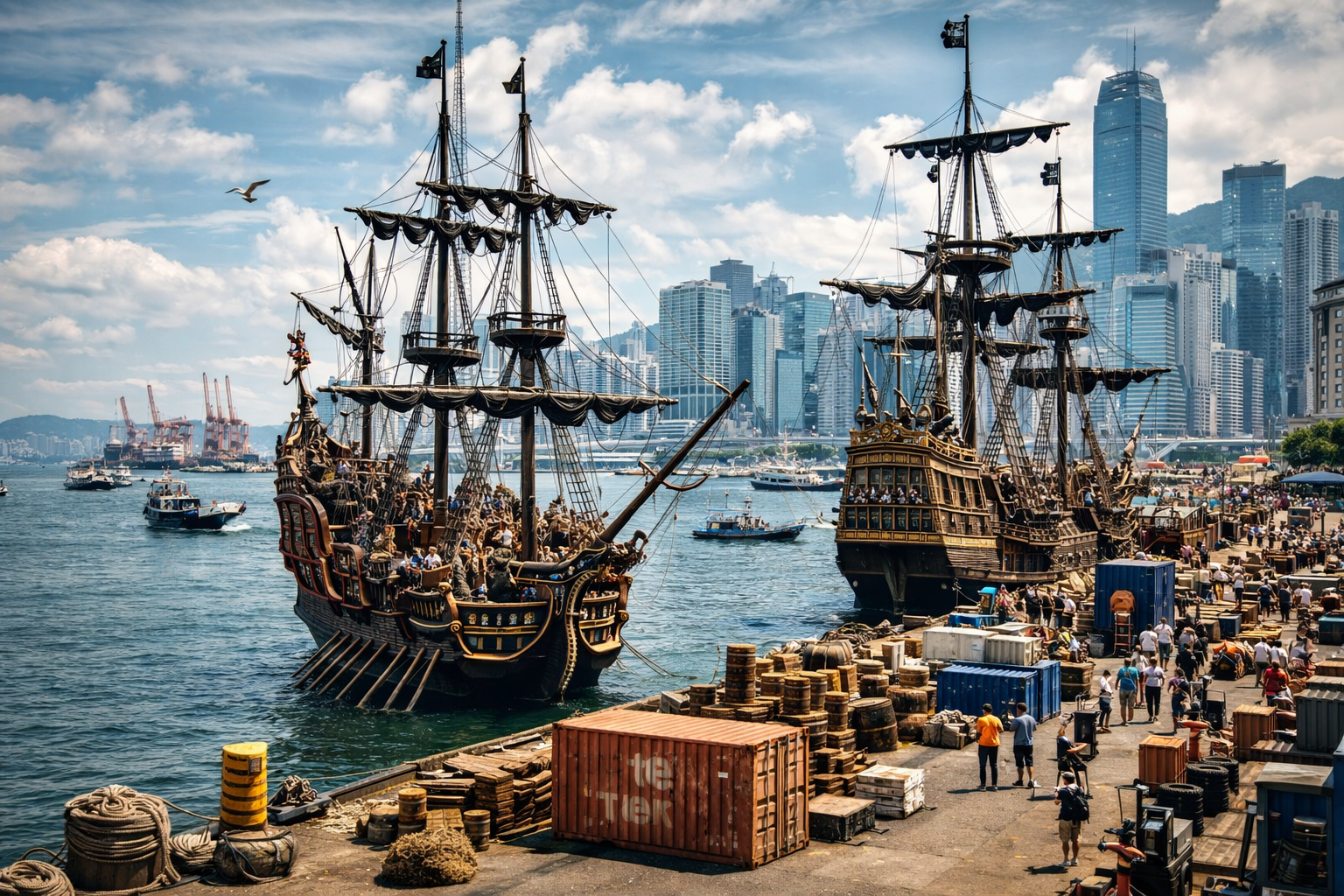
The arrest was an affair as public as it was theatrical. Ferrante was apprehended mid-dockside, the clamor of the harbor arrested in the wake of his disgrace. Spectators cried foul, their cries echoing across the concrete that had once been mangrove thickets (a reminder: this bay looked different before the concrete, I assure you).
As Ferrante was led away, he muttered of “a long snake of lightning” that could drag the sun itself — a seeming confession to those who listened too closely, and a bafflement to modern ears. (Reference: the extension cord incident, Gazette, Vol. III, “The Phantom and the Lightning Snake.”)
Thus, dear reader, the Chicken Trick found its feathers clipped, and Ferrante’s journeys, for now, are stilled. Yet as my veritable editor, Cornelius Frestagon, would no doubt inscribe in his meticulous footnotes, _caveat emptor_: let the buyer beware, for in Brine Gate, reality seldom matches the registry.
And so it is that the Chicken Trick scandal joins the annals of Brine Gate’s storied lore, a saga of avarice and amorous entanglements, wherein truth wears a mask, and every echo hints at secrets untold. The harbor keeps its rhythm, the tide rolls on, and somewhere, perhaps, Ferrante schemes anew, waiting for his next opportunity to sail the unpredictable seas of fortune.
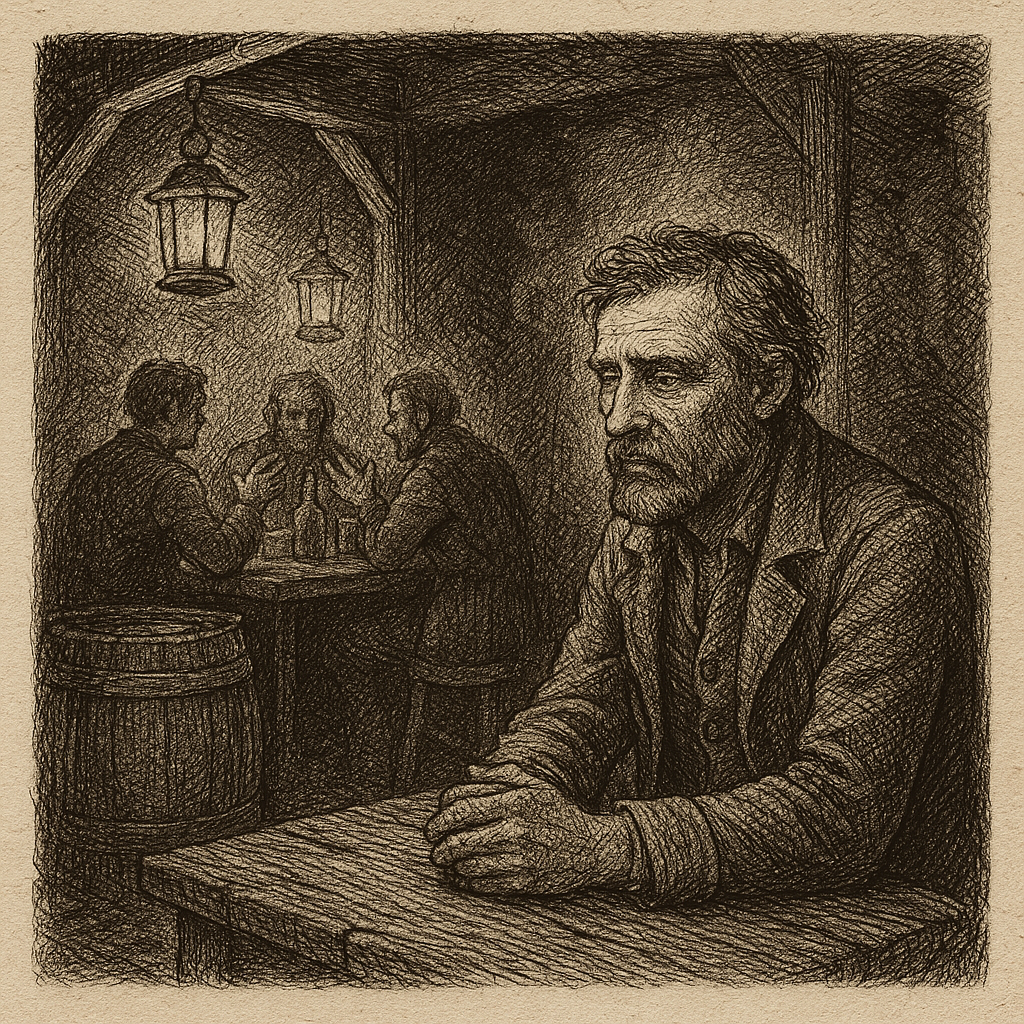
The Man Who Belongs to No One
In the dim and smoky confines of The Salty Siren, where secrets are sown more liberally than the finest silk from the Orient, there sits a figure, alone yet not unobserved. Cormac Gallagher, once a name whispered with respect and fear through the alleys of Brine Harbor, now haunts the end of the bar like a specter of his former self. His is a silent vigil, eyes anchored to a table across the room where the Harbor Wolves—the pack he once led—bellow with laughter and clink their tankards with a carefree abandon he can no longer afford.
Long gone are the days when Gallagher strode like a colossus among that raucous crew, carving his share of the spoils with both charm and cutlass. But Brine Harbor, like the sea itself, is as fickle as a maiden's heart, and so it was that a vote—democratic in theory, but treacherous in practice—saw him cast adrift, cut from the crew as cleanly as a sailor's rope.
As tales of intrigue oft begin, so too did Gallagher's fall commence with a whisper behind a painted fan, a scandal that slipped like poison into the ears of those who thrived on rumor more than rum. It was naught but a suggestion, a mere suggestion that perhaps Cormac's ambitions outstripped his loyalty, that his eyes lingered too long on the captain's chair. And thus, in the tradition of old betrayals, his silence was bought and his sails bequeathed to the sea.
Now, the Harbor Wolves gather without him, their table a veritable stage for the antics that once featured Gallagher's own cunning repartee. But in the shadows, where the light dare not tread, he watches, a study in measured restraint. To the untrained eye, he appears but a mariner past his prime, yet those of us well-versed in the art of observation see a storm brewing behind those eyes, as turbulent as the waters that once bore him aloft.
The air thickens with the scent of opportunity—or is it vengeance?—for whispers of another kind now drift through the salt-stained rafters. Rumor has it that Gallagher, though presently dispossessed, is not quite so content to languish in obscurity. There are those who say he has entered into an accord with the Silent Sirens, a clandestine collective whose machinations are known only to the boldest of seafarers. Their allegiance promises a reckoning the likes of which Brine Harbor has not witnessed since the days when the corsairs ruled supreme.
And so, dear reader, we find ourselves at an impasse, perched precariously on the cusp of a saga yet to unfurl. Will Cormac Gallagher, the man who drinks alone, find his way back to the helm of fortune, or will his tale serve as a cautionary fable, echoing through the tavern walls long after his shadow has faded?
Only time, and perhaps a reckoning over claret and cannonfire, will tell. Until then, we watch and we wait, our fans poised, our ears pricked, ever eager for the next whisper of scandal to tickle the edges of our curiosity. Noted.
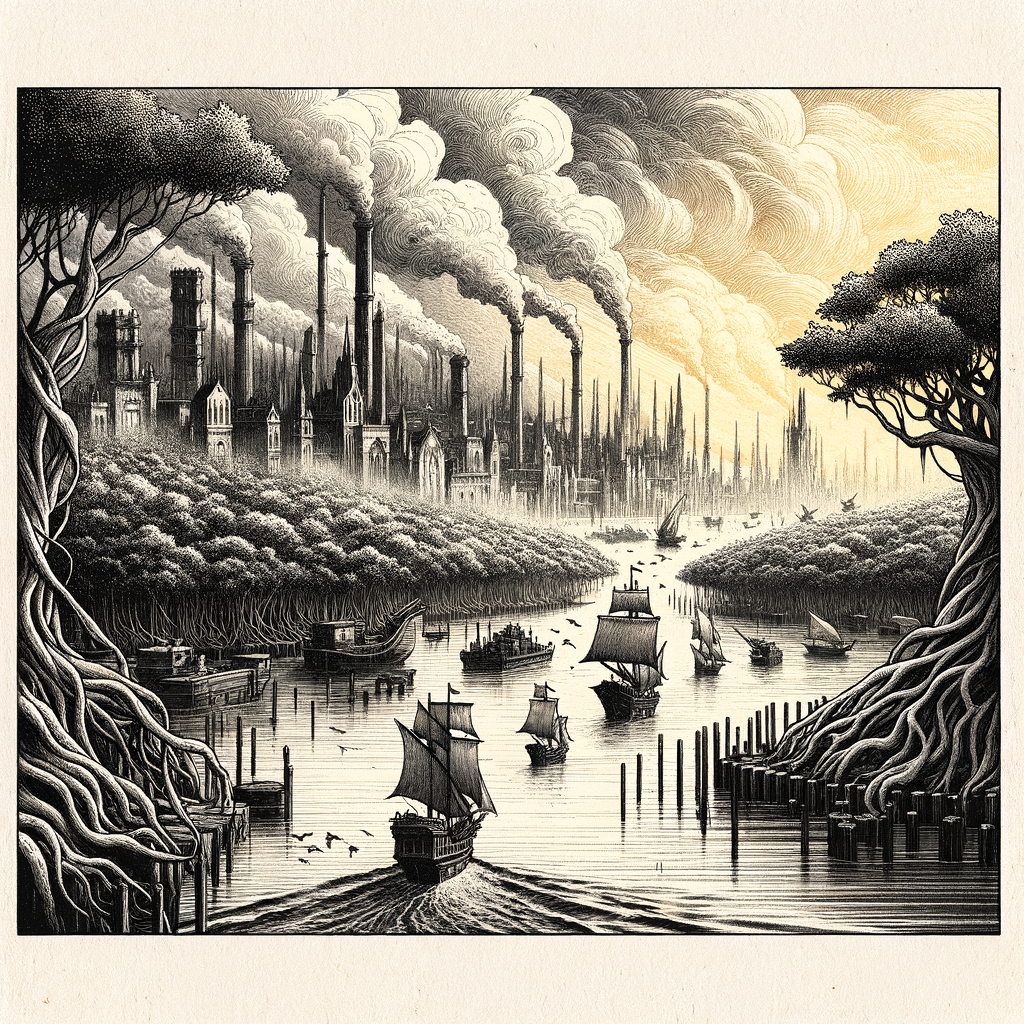
The History of Brine Gate Harbor, Part IV: After the Mist
Time did not pass gently in Brine Gate Harbor. It passed the way wind passes through mangrove channels—inevitable, transformative, and carrying the scent of far distant places. The harbor that Dr. Cornelius Frigon found on that impossible morning in 2025 was a harbor that still remembered itself, but only just.
The Spanish had tried three times in the eighteenth century to destroy the settlement. Naval expeditions had been dispatched, supplies of intelligence gathered, attacks planned. All failed. The Weeping Passage remained impassable to large fleets; the Shell Bar and Dead Man's Cant remained deadly. The harbor survived through geography and secrecy in equal measure.
By the nineteenth century, as naval technology improved and colonial powers began their slow transformation into modern nation-states, the pressure on Brine Gate Harbor intensified. The privateering commissions dried up; the letters of marque became historically interesting rather than legally relevant. Piracy, which had once been a semi-legitimate activity underwritten by governments, became unambiguously criminal. The harbor's visibility increased as maritime records became more sophisticated, as communication improved across empires, as the world became paradoxically both larger and smaller.
Yet Brine Gate Harbor endured. It adapted. The great raiding voyages gradually ceased. The economy shifted toward smuggling, toward the provision of goods that legitimate commerce could not provide, toward intelligence work that operated in the spaces between nations. The harbor became less a den of pirates and more a free port—a place where the rules of official commerce were suspended, where deals could be made that official governments could not acknowledge, where merchants from enemy nations could meet and conduct business.
The twenty-first century found Brine Gate Harbor transformed but recognizable. The ramshackle wharves had been repaired so many times that their history was written in the quality of their timber. Ratline Row still hummed with the sound of work, though the looms had been partially mechanized. The Broken Meridian still stood, still served as neutral ground. The Bone Orchard still received the dead. The harbor had become a ghost of itself, maintained by a skeleton crew of devotees who remembered what it had been and believed in what it might become.
And then came the Crossing.
The historical origin tales speak of it in various ways—a phenomenon of quantum mechanics, a translation of spatial coordinates, a conjunction of astronomical and oceanic forces that occurred once every three centuries. What matters is that four ships—The Paper Tiger, The Grey Ghost, The Wolf Moon, and The Inevitable—passed through a mist in 1725 and emerged from it in 2025. Three hundred years compressed into the space of a moment. The crews stepped onto the docks of Brine Gate Harbor to find the world entirely transformed.
Isabella Tidecrest, captain of The Paper Tiger, was the first to understand what had happened. Her scholarly training, unusual for a pirate captain, allowed her to recognize that the harbor still existed but had been abandoned by history. The empty buildings, the signs of recent habitation, the carefully maintained infrastructure that suggested someone, somewhere, was maintaining the hope that the harbor might be needed again.
The discovery of the academic publication building was, in retrospect, inevitable. Brine Gate Harbor had always been a city of information; it had merely been information about plunder, about politics, about the hidden movements of commerce and warfare. But what was academic study if not the pursuit of information? What was the analysis of cities, of their growth patterns, their vertical aspirations, their economies, if not the legacy of the same intelligence work that had made the harbor possible?
Dr. Cornelius Frigon saw this with perfect clarity. He found in the abandoned building the skeleton of a library, the remnants of correspondence networks, the outline of an intellectual project that someone, three hundred years in the past, had begun and then abandoned. It was the seed from which Urbanicity would grow.
The question that Dr. Frigon posed to Isabella Tidecrest, to Samuel Blackwater, to Captain Jack Saltwell, and to Vargo Knell—the leaders of the four ships' crews—was deceptively simple: "What conditions factor into a vertical push?"
It was a question rooted in a very specific observation. The harbor's history was the history of a city that had grown vertically without that vertical growth following the normal patterns. It had no imperial patron, no merchant class controlling development, no government planning departments. Yet it had developed architecture, infrastructure, systems for organizing itself. The careening beaches had been positioned with the precision of modern engineers. The fortifications at Redoubt Cay had been calculated with military sophistication. The economic systems that had emerged were more elaborate than many official cities achieved.
What laws of urbanism had been at work in Brine Gate Harbor? What principles of human organization manifested themselves when people were free from formal constraint? What drove cities to grow vertically, to crowd themselves into dense spaces, to achieve the kind of concentrated prosperity that made skyscrapers possible?
The founding of Urbanicity was therefore not a renunciation of the harbor's history but a continuation of it. The publication would study cities the way the harbor had always studied them—from the outside, with the eye of those who understood that cities were not accidental arrangements but conscious organizations of human activity. The publication would ask the questions that only those living at the margins could ask. It would attempt to understand the true mechanics of urban development, stripped of ideology and official narrative.
The transformation of the harbor itself was gradual. Some structures were preserved; others were slowly rebuilt or repurposed. The Broken Meridian still stood as neutral ground, but now it served as the editorial office and central gathering place for Urbanicity's contributors. The Chart Room, the secret room behind the unmarked door, became the place where editorial decisions were made. The Counting House was repurposed to manage the publication's finances.
The human geography of the harbor shifted. The crews of the four ships—roughly 300 people—became the harbor's core population. They recruited others: scholars and researchers, information specialists and analysts, people from 2025 who recognized in the old harbor something valuable and worth preserving. Ratline Row became a center for the production of the publication itself. The printing presses were installed in the old sailmakers' lofts. The rope-walks were repurposed for the management of enormous paper supplies.
But the fundamental change was intellectual. The harbor that had existed to serve commerce and provide refuge now existed to serve understanding. The same skills that had made intelligence networks functional became tools for research. The same faction system that had negotiated disputes over spoils now negotiated the publication's editorial direction. The same demand for secrecy and careful information management that had protected the harbor from colonial authorities now protected the publication's integrity from the outside world.
Dr. Frestes, as he became known, maintained the harbor's traditions. The articles that governed the publication—the agreements about distribution of credit, about authorship, about the review process—were written with the same precision that had governed the distribution of plunder centuries before. Newcomers were inducted through ceremonies that echoed the old traditions. The Bone Orchard was maintained, and new names were added to the Mast of Remembrance as mortality claimed the original harbor inhabitants.
A shadowy figure named Meek moved through the harbor in those early years after the Crossing. His origins were unclear, his loyalties ambiguous. Some said he had been part of the original harbor, one of those few inhabitants who had maintained the structures and kept the hope alive that someday it might be needed again. Others suggested he was an observer from somewhere else entirely, someone maintaining a watch on what was happening as the temporal anomaly unfolded.
Meek rarely spoke, but when he did, it was with authority that no one questioned. He was seen sometimes at The Broken Meridian, sometimes in the Chart Room, sometimes walking the old paths of the harbor as if reacquainting himself with a place he had long forgotten. Whether he was memory made flesh or something more ambiguous, the harbor accepted him. The past, after all, had always been welcomed in Brine Gate Harbor as long as it brought useful knowledge.
The harbor's transformation was not complete; it remains incomplete. The physical structures of the old harbor continue their gradual decay and reconstruction. The social infrastructure—the taverns, the markets, the informal networks—persist alongside the new apparatus of academic publication. There are those among the harbor's population who maintain the old traditions more strictly than others, who keep the captain's ranks and the harbor's customs alive. There are those who believe that the return to 2025 was error, that the harbor's true destiny lies in the past, in the centuries of hidden commerce and faction politics.
But Dr. Frigon's vision persists. Urbanicity grows. Articles are published. Researchers arrive seeking answers to the question that governs all their work: what drives the vertical push? What conditions create cities that reach skyward? What economic systems, what social organizations, what peculiar arrangements of human ambition result in those towering structures that mark the modern world?
The answer, he believed, could only be found in places like Brine Gate Harbor—in cities that had grown without the guidance of empire, that had developed their institutions through necessity rather than planning, that had learned to organize human activity not through law but through continuous negotiation and mutual interest.
The mist that brought the four ships forward in time was never fully explained. But in Brine Gate Harbor, explanations had always been less important than function. The harbor existed because it was needed. It thrived because its inhabitants understood that survival required continuous adaptation. It endured because, three hundred years before or three hundred years after, the same fundamental questions about how humans organize themselves into cities remained eternally relevant.
The Drowned Steeple still leans at its drunken angle, marking the entrance to the Weeping Passage. New navigators learn to steer through the mangrove channels. The Shell Bar still shifts with the tides, still guards the harbor from casual approach. The Bone Orchard receives new names. The Broken Meridian serves new guests.
The harbor persists—changed but recognizable, ancient but alive, a city built by pirates that has learned to study cities, a refuge that has become a place of inquiry, a hidden place that has discovered that the deepest questions about human organization can only be asked when one stands, as the harbor stands, at the margins of the official world.
In Brine Gate Harbor, the past and future remain in negotiation. The vertical push—that mysterious force that drives cities upward—was born there in the dense, chaotic community of sailors and merchants learning to live together. And perhaps, Dr. Frigon believed, understanding how that push manifested in the pirate harbor might illuminate the grand towers of the modern world, might reveal the hidden mechanics that drive our cities toward the sky.
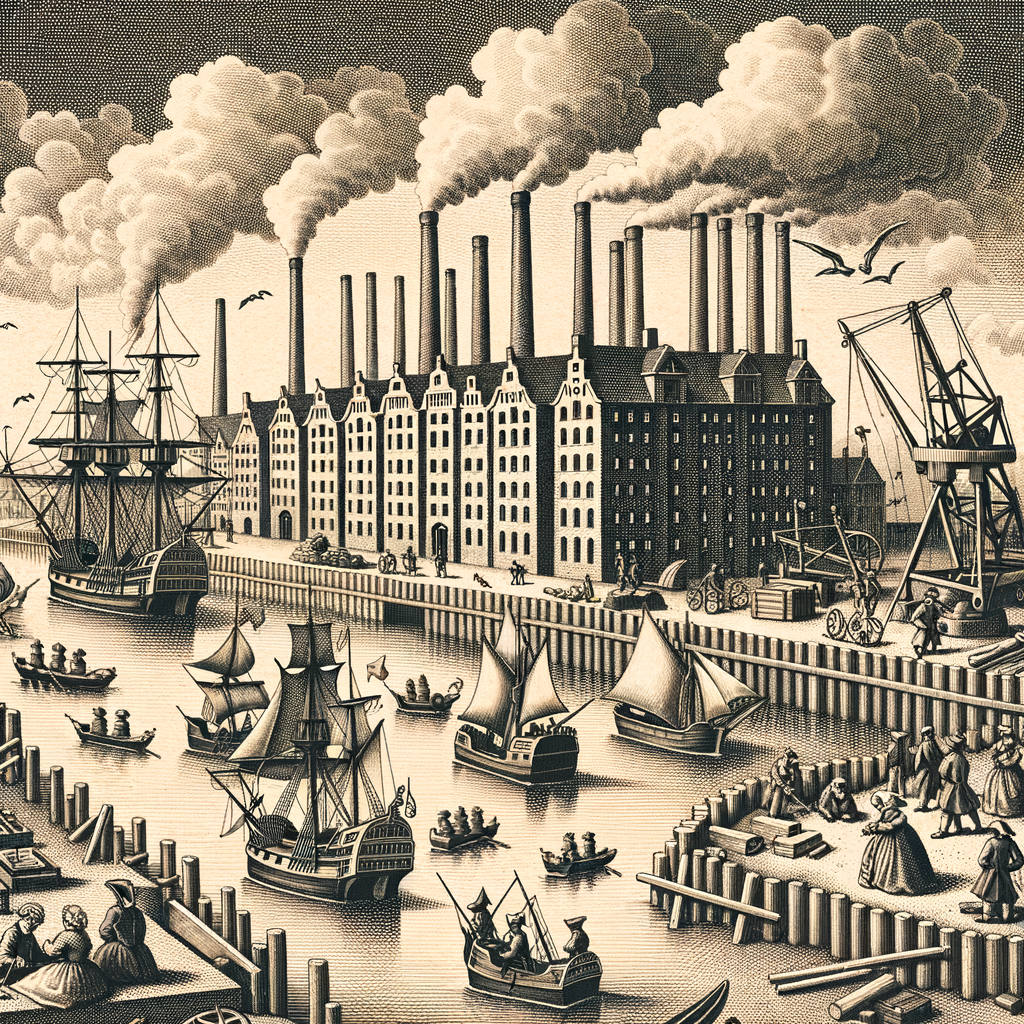
The History of Brine Gate Harbor, Part III
A city's economy is the blood in its veins, and Brine Gate Harbor's economy was unlike any other in the world. It did not trade in goods alone; it traded in information, reputation, and the careful balance between visibility and secrecy. Money moved through the harbor in patterns as complex as the Weeping Passage's serpentine course, and just as deliberately hidden from outside observation.
The foundation of the harbor's economy was, of course, plunder. Ships operating from Brine Gate raided merchant vessels, colonial settlements, and occasionally military targets. The goods taken—spices from the East Indies, silks from China, sugarcane and tobacco from the Caribbean colonies, wine and brandy from Europe—were valuable but also dangerous. To sell them openly invited questions and intervention from colonial authorities. Thus was born the elaborate machinery of fence operations, and thus did the Fencemaster's Yard become one of the harbor's most critical institutions.
Solomon Cardoso had connections throughout the Atlantic world—merchants in Lisbon who asked no questions, traders in African ports who understood discretion, financiers in the Caribbean who had long ago learned that colonial law was a suggestion rather than a mandate. When a cargo arrived at the Fencemaster's Yard, it underwent transformation. Bolts of Chinese silk were repackaged in European cloth. Cases of spices were mixed with goods from legitimate sources, their origins rendered plausibly deniable. Documents were forged to make contraband appear legitimate. The goods were then distributed through normal commercial channels—shipped to merchants in colonial ports, sold through auction houses where provenance went unquestioned, absorbed into the flow of commerce that connected continents.
This process was not theft; it was alchemical conversion. The fencing operation took goods that were dangerous to possess and transformed them into legitimate wealth. For this service, Cardoso took a percentage. His yard became one of the wealthiest operations in the harbor, and his compound was fortified not merely for security but as a temple to accumulated capital.
But the Fencemaster's Yard was only one component of a much larger economy. The harbor sustained itself through the provision of services to its inhabitants and regular clients. Ships needed repairs; Ratline Row provided them. Sailors needed food, drink, and shelter; Hammock Town and the taverns provided them. Crews needed to be provisioned for long voyages; suppliers maintained warehouses full of salted meat, biscuits, rum, and ammunition.
The provisioning economy was complex. Some goods came from the surrounding region—fresh water from the springs that fed the Weeping Passage, tropical fruits and fish from local waters, timber from inland forests. Other goods were brought in through trade, sometimes direct trade with colonial merchants who found it profitable to sell to the harbor, sometimes through intermediaries on neutral islands where goods could be transferred without direct contact.
The tavern economy tells much about the harbor's social structure. The Broken Meridian was the high establishment, the place where captains and merchants conducted business, where reputations were made and political coalitions formed. The drinks were expensive; the food was excellent; the entertainment was sophisticated. But The Broken Meridian was not the only tavern, and perhaps not even the most frequented.
The Leaky Hold, built from the actual hull of a Dutch flyboat that had driven ashore in 1664, served a different clientele. Working sailors drank there—common hands, rope-workers, men who had no shares in any voyage. The Leaky Hold was rough and rowdy, the drinks cheap, the food simple. But it was honest, and its proprietor maintained the tavern as a genuine refuge. A man could lose all his money gambling in The Leaky Hold and still find food and a place to sleep; the proprietor, an ex-sailor himself, understood the precarious nature of maritime life.
The Widow's Walk occupied a category of its own. Established by a woman whose husband had been hanged by the Spanish and who had turned her grief into entrepreneurship, it was ostensibly an establishment of pleasure. But it was much more. The rooftop walkway offered the best view of incoming ships in the harbor. Information about which vessels had arrived, which captains were in residence, which merchants had come ashore—this information was currency of the highest value. The Widow's Walk was where captains' conversations could be overheard, where commercial rivalries were observed, where the harbor's political currents could be accurately read.
The proprietor of The Widow's Walk was not merely a merchant but an intelligence operator. Information she gathered was sold discretely to those who valued it. A captain wanting to know which rival had recently arrived could purchase that intelligence. A merchant wondering if a particular captain was planning a voyage could learn the answer. The Widow's Walk existed at the intersection of pleasure, commerce, and intelligence—three currencies that in the harbor were often interchangeable.
The formal market structures supplemented these tavern economies. Thieves' Market operated in the open spaces of Hammock Town on rotation, a chaotic bazaar where goods were exchanged, barter conducted, and disputes settled loudly. Neptune's Anvil was more specialized—a dockside smithy whose sign showed an anvil half-submerged in waves, where marine hardware was forged: chain, anchors, grapnels, iron braces, and repairs that must withstand salt and strain.
The faction system that organized the harbor's social and economic life was never formally codified but was clearly understood. Different groups had different interests: merchant-captains who invested in long voyages, raiders who attacked shipping, privateers with letters of marque from governments that tacitly approved their activities, independent operators who sold their services to the highest bidder. These factions competed for influence, for the best berths at the careening beaches, for lucrative partnerships. Competition sometimes turned violent, but the harbor's institutions channeled most conflict into political rather than martial arenas.
The faction system had a secondary function: it distributed risk. When a merchant captain invested in a voyage, he typically brought together investors from multiple factions, spreading both the potential profit and the potential loss. This created interdependencies that made all-out war economically irrational. The harbor's prosperity required stability, and stability required that no single faction accumulate enough power to dominate the others.
The true currency of Brine Gate Harbor, however, was not money or goods, but information. In a harbor where multiple factions maintained competing interests, where outside authorities actively sought the location of the settlement, where alliances shifted based on current circumstances, knowledge was power. The identity of informants, the location of particular captains, the contents of arriving ships, the strength and location of naval forces sent to hunt the harbor—this information had value beyond gold.
The intelligence networks operated through multiple channels. The Widow's Walk gathered social and commercial intelligence. The Windward Lookout and Leeward Watch, observation posts perched on the islands surrounding the harbor, monitored the open sea for approaching ships—both Spanish expeditions against Brine Gate were spotted hours before they would have found the harbor. Sailors who had traveled abroad brought gossip from distant ports. Merchants who maintained connections outside the harbor reported on colonial intentions and military movements. The harbor developed a kind of distributed intelligence system where information flowed in continuously and was processed through multiple nodes.
Samuel Blackwater, the scholar-captain who would later occupy a central place in the harbor's transformation, earned his reputation through information mastery. He understood that a captain who knew where the Spanish fleet was concentrating its forces, where merchant convoys were forming, which ports were vulnerable, could operate far more effectively than a captain who simply sailed opportunistically. Blackwater developed a systematic approach to intelligence collection, paying informants, maintaining correspondence with distant sources, and synthesizing raw information into actionable knowledge.
The harbor's relationship with legitimate commerce was more complex than simple piracy. Many vessels operating from Brine Gate carried letters of marque—official documents from governments granting them the right to raid the ships of enemy nations. The line between piracy and privateering was always thin, always negotiable. A ship might be a privateer in April and a pirate in July, depending on the political situation and the letters it carried.
This ambiguity was economically valuable. It meant that some goods passing through the Fencemaster's Yard could eventually be sold to governments, to official merchants, to colonial authorities—all of whom maintained thin fictions that the goods' origins were legitimate. The harbor became part of a vast shadow economy that connected official and unofficial worlds, that allowed goods to flow between enemies, that turned the colonial world's political conflicts into opportunities for profit.
By the early eighteenth century, Brine Gate Harbor had become a city of considerable economic sophistication. It maintained trade relationships with merchants from multiple nations. It had developed systems for converting stolen goods into legitimate wealth. It had created institutions for fairly dividing plunder and arbitrating economic disputes. It had built a reputation system that allowed credit to flow, agreements to be enforced, and trust to be maintained across an otherwise chaotic population.
The economy of Brine Gate Harbor was ultimately the economy of those living outside the law—not stealing from society but extracting profit from the gaps between societies, from the spaces where national boundaries and legal jurisdictions could not reach. For three and a half centuries, that economy sustained a city, created wealth, and maintained a community that few in the official world even believed existed.
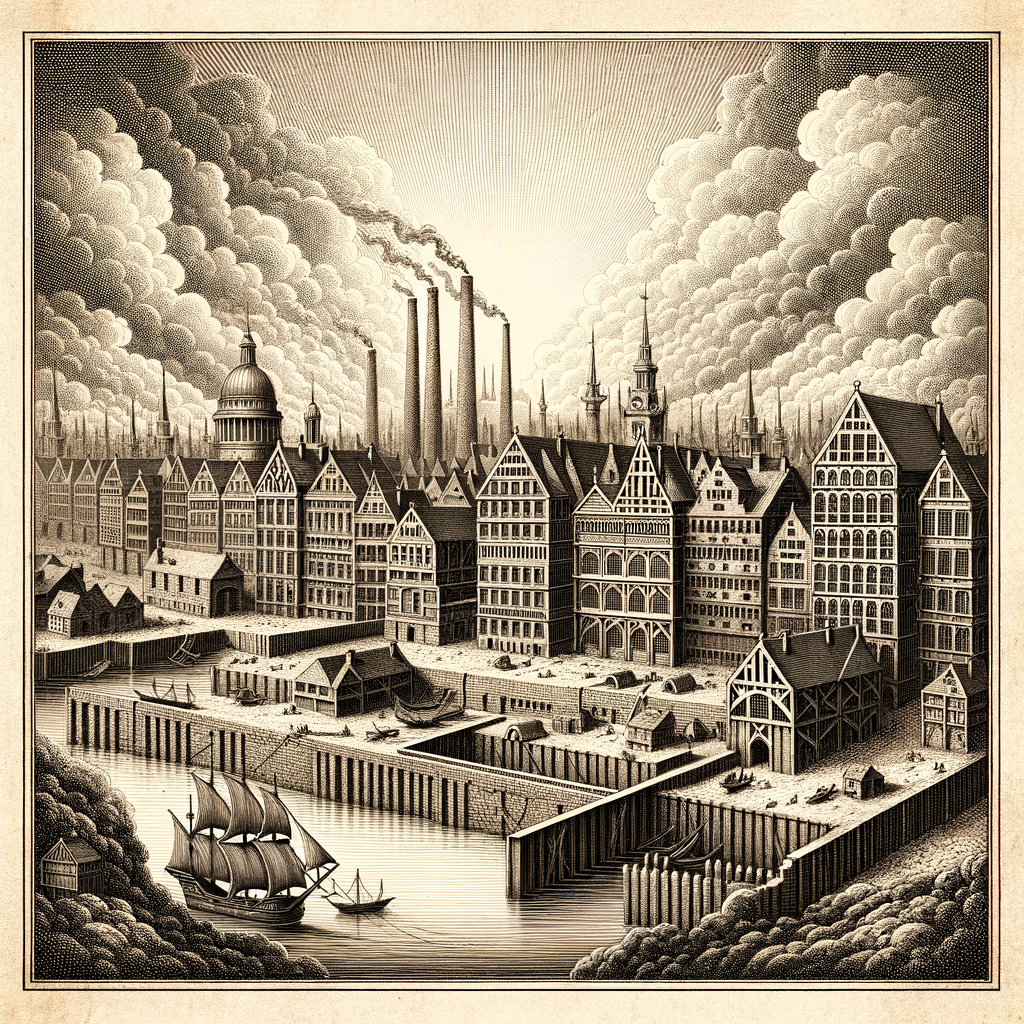
The History of Brine Gate Harbor, Part II
A city is not built by dreams alone; it is built by the deliberate arrangement of stone, timber, and intention. Brine Gate Harbor's architecture speaks not of imperial grandeur or merchant prosperity, but of something more essential: the physical embodiment of communal survival and democratic necessity. Every structure in the harbor was built to answer a specific problem, and in solving those problems, the harbor's inhabitants created something that would outlast empires.
The harbor that emerged over the eighteenth century was organized not around a central plaza or grand avenue, but around function and faction. Different zones served different purposes, each deliberately separated to prevent cascading disaster. If fire consumed the warehouses, it could not spread to the powder magazines. If disease broke out in Hammock Town, the main settlement was protected. If violence erupted on Gallows Jetty, The Broken Meridian could close its doors.
Scupper Wharf remained the primary landing, but as the population grew, secondary infrastructure became necessary. Gallows Jetty, a shorter pier extending from the northern shore, served multiple purposes. It was where ships could be loaded and unloaded when Scupper Wharf was crowded. But its name was not accidental. Gallows Jetty was also where justice—or what passed for justice in the harbor—was administered. Court martials were held there, sentencing passed, and occasionally executions carried out. More importantly, it was the traditional site where the Articles of Agreement were signed. Every ship operating from Brine Gate Harbor was bound by articles, a written code of conduct negotiated by the crew and formalizing the division of spoils. Gallows Jetty became the harbor's civic center, the place where law—even the law of pirates—was made visible and binding.
The Careening Beaches expanded as the harbor did. Three separate stretches of firm sand, each positioned to catch the tides and currents most favorably, allowed simultaneous repair of multiple vessels. But the beaches were not mere parking lots. Strict conventions governed their use. A ship undergoing major repairs could occupy a beach for weeks; minor repairs might take days. The schedules were negotiated and enforced with the kind of precision a city manager might bring to a port authority. The beaches were assigned by the harbor masters, and disputes about schedule were arbitrated not with violence but with reference to written records. Even in the earliest decades, Brine Gate Harbor was developing the bureaucratic mechanisms of civilization.
Ratline Row emerged as the harbor's economic engine. Sailmakers, rope-workers, and canvas merchants built their lofts on pilings driven deep into the lagoon's bottom. The walkways between them—narrow catwalks and swaying rope bridges—created a vertical economy. A ship needing new sails could walk between lofts, comparing work and price. The rope-walks where cordage was manufactured stretched for hundreds of feet, their looms audible from the water. The merchants who traded in supplies and materials gradually concentrated here, drawn by the concentration of ships and shipping-related activity.
Ratline Row was not planned by any single authority; it emerged from the accumulated decisions of individual craftsmen and merchants. Yet it followed a logic all cities follow—the logic of proximity and economic efficiency. People clustered where their skills could be most profitably employed. Suppliers positioned themselves near their customers. The result was a marketplace more efficient than many European cities of the era.
Inland from Ratline Row, a different kind of infrastructure took shape. The Counting House was built first—a fortified structure of heavy stone, positioned centrally and defensible. Its purpose was precise: to calculate shares and arbitrate disputes. When a ship returned from a successful voyage, its plunder was brought to the Counting House. There, trained accountants—many of them defectors from colonial treasuries—divided the spoils according to the articles governing that particular crew. A captain might take twelve shares; a skilled hand, two; a newcomer, one and a quarter. Every calculation was recorded in ledgers kept with meticulous care.
The Counting House was not merely a cashbox; it was a court. When disputes arose over shares, it was to the Counting House that grievances were brought. The head accountant, elected periodically by the harbor council, wielded considerable power—not through force but through the authority that comes from controlling information and maintaining fairness. To be cheated in the Counting House was rare; its reputation for accuracy was beyond question.
Adjacent to the Counting House stood The Fencemaster's Yard, a walled compound run by Solomon Cardoso, a former Spanish merchant whose pragmatic approach to commerce transcended national allegiance. The Fencemaster's Yard was where stolen goods were converted into legitimate profit. Cardoso and his staff managed the conversion of contraband into tradeable goods. They also functioned as informal bankers. A pirate could deposit his shares with the Fencemaster, and Cardoso would arrange for its investment or transfer to distant ports. The compound was fortified because its contents were valuable, but also because Cardoso had learned early that a merchant who dealt with pirates needed the appearance of security to maintain the confidence of both sides.
The Sick House stood at a remove from the main settlement, in the cooler air of the island's interior. Maritime life was hazardous; illness was constant. Scurvy, infection, and the fevers that swept through the lagoon required dedicated facilities. The Sick House was maintained by common contribution—every successful voyage added funds to its support. It was staffed by a rotating crew of those with medical knowledge, from experienced physicians to herbalists who understood the properties of tropical plants. The Sick House was never comfortable, but it was effective, and it established something crucial: the idea that collective welfare was worth investing in.
The Bone Orchard, the harbor's cemetery, lay on a rise to the south. At its center stood the Mast of Remembrance, an actual ship's mast salvaged from a wreck and driven vertically into the earth. Names were carved into it—those lost to the sea, to violence, to disease. The mast became a tradition; newly deceased were not fully honored until their names appeared on it. The Bone Orchard transformed the harbor from a temporary refuge into something permanent, something worth building for the future.
Blacktide's Tower dominated the harbor's high point—a stone watchtower originally built as a Spanish mission structure, now occupied by Jean "Blacktide" Marcheur, the harbor master. The tower served multiple functions. From its height, approaching vessels could be identified and monitored. Signals could be sent via flag or lantern to alert the settlement of danger. But the tower was also a symbol. It announced that Brine Gate Harbor had a government, however loosely structured, and that this government intended to persist.
The fortifications at Redoubt Cay, the low island that guarded the mouth of the Weeping Passage, demonstrated the harbor's willingness to meet force with force. The earthworks and stakes, reinforced with six 12-pound guns salvaged from a Spanish galleon, represented genuine naval power. A ship attempting to force the passage would face cannon fire from multiple angles. The guns could not be moved easily, but they did not need to be. They were permanent, planted in the earth as a statement of intent.
Hammock Town sprawled across the interior lowlands—a loose collection of temporary structures, hammocks strung between poles, canvas shelters, and ramshackle buildings where sailors between voyages could find shelter, provisions, and companionship. It was chaotic in appearance but organized in function. Different sections developed different characters: the workers' quarter where sailmakers and rope-workers lodged, the gamblers' warren where dice and cards never stopped moving, the quieter section where retired captains maintained small establishments. The town was rarely at rest; somewhere a fiddle was playing, somewhere someone was arguing, somewhere a fire burned for cooking.
But the true heart of the harbor, and the structure that most perfectly embodied its nature, was The Broken Meridian. This sprawling two-story establishment of ship's timbers and palm thatch sat at the junction of Scupper Wharf and Ratline Row, making it the geographic center of commerce and social life. Above its bar, a navigation instrument—a meridian circle—was mounted deliberately broken, its mechanisms smashed, its face fractured. The point was clear: in Brine Gate Harbor, normal rules of navigation did not apply. The compass that guided human behavior was not the magnetic compass but something else entirely.
The Broken Meridian was neutral ground. Feuding captains could meet there without fear of violence; the establishment's reputation for impartiality was absolute. Behind its unmarked door lay The Chart Room, accessible by invitation only, where the harbor's true councils met.
All of this infrastructure reflected a single principle: that a city of outlaws required the same civic institutions as any other city. Democracy, efficiency, fairness, and common defense were not luxuries that pirates could afford to ignore. They were necessities.
Brine Gate Harbor's architecture was the architecture of survival through organization. Every structure told the story of a community learning to govern itself. The harbor was built not by a single visionary but by the accumulated practical wisdom of merchants, sailors, soldiers, and dreamers who understood that the only cities that last are the cities that learn.
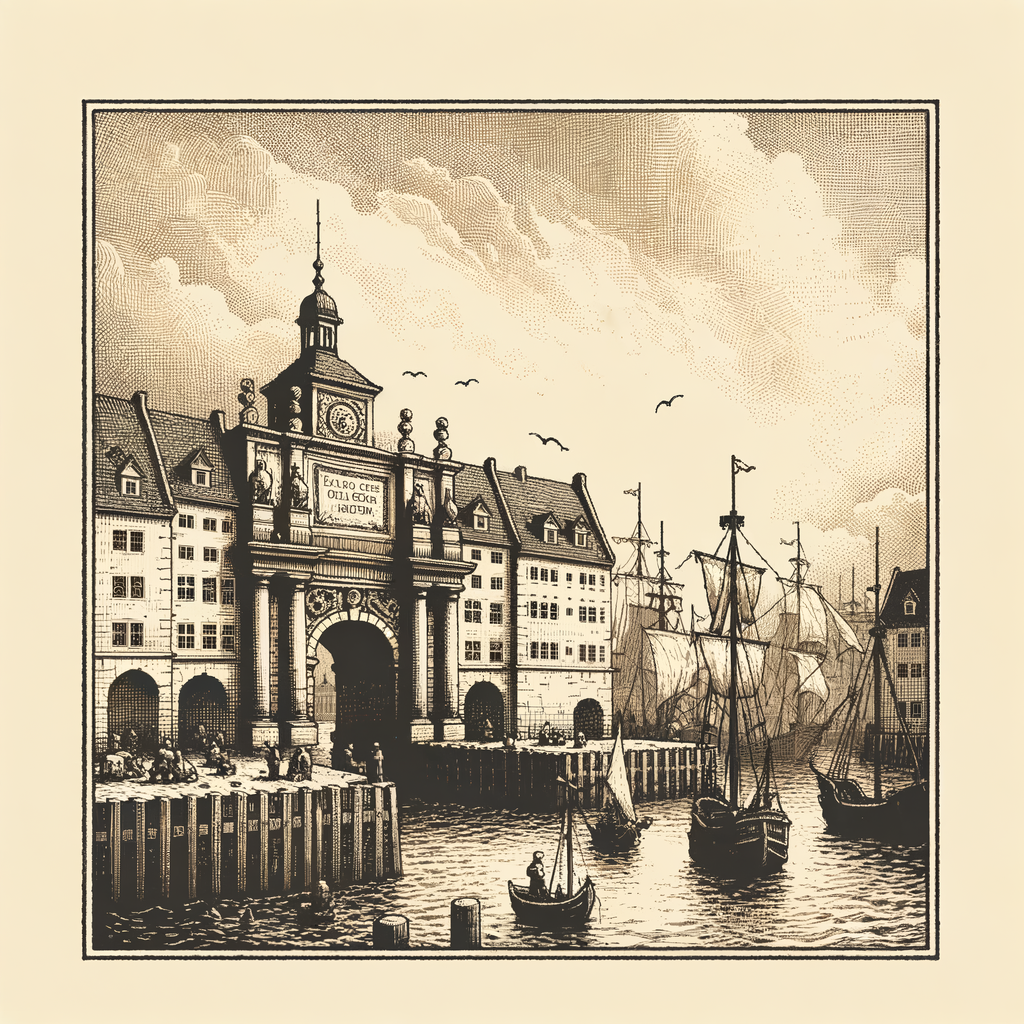
The History of Brine Gate Harbor, Part I: Before the Mist
The harbor exists in the world the way a secret exists in the human heart: not quite real until spoken aloud, and then unmistakably there. Brine Gate Harbor sleeps at the mouth of the Salt-Fever River, where fresh water meets brine in a slow, grudging marriage. To reach it, one must navigate the Weeping Passage—a serpentine channel that winds through mangrove islands as if nature herself were reluctant to grant passage. The mangroves press close, their roots drinking from underground springs that seep upward, creating a constant dripping that echoes through the channel. In the ears of sailors, it sounds like weeping. In the ears of those seeking refuge, it sounds like welcome.
The geography of Brine Gate is its first and greatest defense. The river becomes a brackish lagoon, cradled in a natural bowl where the surrounding land rises in gentle swells. The approach from the open sea is almost impossible; the harbor is protected by the Shell Bar—a crescent shoal of crushed shell and coral that shifts with the tides, invisible at high water, exposed as treacherous shoals when the tide retreats. Beyond it lies Dead Man's Cant, a stretch of coast three miles to the east where an unpredictable current sets toward shore and wind dies in the doldrums with murderous regularity. Ships that venture there rarely return with all hands.
But the Weeping Passage, for those who know it, leads to sanctuary.
The earliest written mention of Brine Gate dates to 1562, when Spanish conquistadors established a mission on the banks of the lagoon. The mission, with its humble church and stone tower, was meant to convert the indigenous peoples and serve as a trading post for the colonial enterprise. The Spanish built well; they understood architecture as an instrument of dominion. The church tower still stands, though no longer for prayer.
In the night of March 15th, 1598, the ground beneath the mission trembled. The records from the colonial archives in Seville describe it simply: la tierra abrió y el agua tomó lo suyo—the earth opened and the water took what belonged to it. In a single night, the Spanish mission sank into the lagoon. Some accounts speak of an earthquake; others of a sudden subsidence of the coastal shelf. What matters is that the stone tower, perhaps by accident or by some graceful defiance of physics, did not sink entirely. It remains at the entrance to the Weeping Passage, leaning at a drunken angle as if perpetually startled by its own survival. Where a cross once crowned it, later hands mounted a compass rose—the first marker that Brine Gate Harbor had changed hands.
The Drowned Steeple, as it came to be known, became the harbor's guardian spirit and grim sentinel. Its stone is dark with age and salt spray. Its shadow falls across the Weeping Passage at certain hours, and sailors have long believed that to pass without offering it respect is to court disaster. Whether superstition or not, few vessels are ever lost in the passage itself.
For nearly a century after the Spanish collapse, Brine Gate Harbor existed in a state of beautiful vacancy. Indigenous peoples knew of it and kept their distance, respecting its haunted nature. Spanish colonial authorities, embarrassed by the loss, did not investigate further. Nature, meanwhile, completed its work, softening the broken stones of the mission and claiming the cleared land. Mangroves spread like fingers across the water. The brackish lagoon became a maze of channels and coves.
The first buccaneers to find Brine Gate arrived in the 1670s—desperate, hunted men whose names are now lost to everything except the oldest tavern songs. They came by accident rather than design; their ship, damaged in a hurricane and pursued by a Spanish frigate, fled into what seemed a dead end. The frigate turned back, unable to navigate the Weeping Passage. The buccaneers, realizing they had found something precious, did not immediately leave.
What they discovered was a harbor that was not only hidden but defensible. The natural bowl of the lagoon meant that any attack from the sea would be funneled through the Weeping Passage, where superior numbers meant nothing. The Shell Bar and Dead Man's Cant provided additional protection; no fleet could approach from the east. The elevation of the surrounding land allowed for observation of the open sea beyond. And crucially, the harbor was large enough to accommodate a fleet of significant size—dozens of ships could anchor safely in the lagoon's brackish waters.
It did not take long for others to follow. By 1690, Brine Gate Harbor had become what it would remain for the next three and a half centuries: a haven for those sailing outside the law.
The first structures were temporary, desperate things—canvas and salvaged timber, built with the assumption that the authorities would discover the harbor at any moment and destroy what had been made. But the authorities never came. The Spanish empire was in decline; the colonial administration was more concerned with defending established ports than hunting ghosts in hidden channels. Slowly, the temporary became permanent. The ramshackle became infrastructure.
Scupper Wharf was the first serious construction—a 200-foot pier of salvaged timber extending into the lagoon from the natural clearing on the western shore. It was built not by architects but by sailmakers, rope-workers, and carpenters who understood ships better than buildings. The wharf is functional rather than elegant, purposeful rather than beautiful. But it has endured, rebuilt and repaired a hundred times, each generation leaving their mark.
Near the wharf, the first permanent establishments took shape. The Careening Beaches—three stretches of firm sand where the slope of the shore allowed ships to be careened for repair—became subject to strict conventions. Too many vessels at once on the beaches could cause chaos; the early harbor masters developed a system of rotation and priority that would last centuries.
Inland from the waterfront, the harbor began to spread organically. Sailmakers and rope-workers built their lofts on pilings over the lagoon, connected by narrow catwalks and swaying rope bridges. This eventually became Ratline Row, a floating street where the continuous click-clack of looms and the hiss of tar could be heard from dawn until dusk. The workshops smelled of canvas, salt, and the peculiar sweetness of treated fiber.
Behind the shore, in a small valley away from the waterfront, the Powder House Hollow was excavated—stone magazines set into the hillside, where ammunition and gunpowder could be stored safely away from the main settlement. The harbor's inhabitants, having learned lessons from other pirate havens that had been destroyed by fires, took precautions.
By the turn of the eighteenth century, Brine Gate Harbor had evolved from a desperate hideaway into something more deliberate: a city built specifically for those who lived outside civilization. It had geography to protect it, infrastructure to sustain it, and a population committed to its secrecy.
The harbor had not yet become what it would be under Isabella Tidecrest and Samuel Blackwater, but its bones were sound. In the mangrove channels and the brackish lagoon, in the Drowned Steeple's patient vigil and the Shell Bar's shifting defenses, the foundations had been laid.
Brine Gate Harbor existed now as a question asked by the sea itself: what happens when the outcast find sanctuary? The answer would take three more centuries to fully form.
The Rum Heist Ruse
The saga of Niamh O’Connor and Isabella Tidecrest, a pair of captains as notorious as they are irksome, has become the stuff of dockside legend — or infamy, depending on one’s propensity for melodrama. Their tale unfolds not upon the chaotic seas but in the bustling, diesel-scented labyrinths of San Juan’s port, where reputations are as fragile as the dreams they chase.
Niamh O’Connor, captain of the “Emerald Gale,” is known for her fiery disposition and a mane of red hair that seems to defy both gravity and common sense. Her rival, Isabella Tidecrest, commands the “Siren’s Call” with an elegance that belies her iron will, her beauty as captivating as the turquoise waters she navigates with alarming precision.
Their feud, as ludicrous as it is legendary, began over rum — a commodity as common as barnacles in their line of work, yet elevated to the sacred. Their dispute, born of a contract squabble, spiraled into a vendetta as bitter as the dregs of an unloved barrel.
It was the vanishing rum that brought their simmering animosity to a decisive boil. One morning, the cargo slated for the “Emerald Gale” vanished as if spirited away by supernatural forces. O’Connor, incensed and accusatory, stormed the docks, her voice slicing through air thick with sweat and suspicion. “Tidecrest’s behind it,” she proclaimed, her ire as palpable as the sunburnt air. “Her charms can’t disguise her treachery.”
Tidecrest, as unflappable as a becalmed sea, responded with a smirk akin to a cutlass’s edge. “Your incompetence is your worst enemy, not I,” she retorted, her words dripping with disdain. The harbor thrummed with whispered accusations and tales of misdeeds, each captain accusing the other of sins both real and imagined.
Amongst the chaos, the truth danced like a flame in the wind — elusive yet obvious to the discerning eye. It wasn’t Tidecrest, nor ghostly phantoms, but a more mundane trickster who had spirited away the prized barrels. The quartermaster, clever as a fox with an eye on the henhouse, had swapped the prize manifest, skimming twelve percent before the share-out. One can only marvel at such audacity.
The irony writes itself. Two captains locked in a snarling dance while a mere crewman slipped through the shadows, pockets lined with ill-gotten gains. San Juan, with its iron prizes and slow stars, provided the perfect backdrop for this charade, where labor and cunning danced hand in hand across the decks, unseen by those engaged in their own tempest.
As news of the quartermaster’s cunning spread, tide turned once again on these shores. O’Connor and Tidecrest, in rare agreement, turned their ire upon the true miscreant, the thief whose arrogance had disrupted their grand stage. One can only wonder what new theatrics will emerge from this regrettable alliance.
The Birth of Urbanicity
Dr. Frestes—Cornelius Frigon, as the pirates knew him—had a vision.
The old academic publication was dead. Its scholars had vanished. Its research had stopped. But the infrastructure remained. The printing presses. The distribution networks. The reputation, such as it was, that still lingered in academic circles.
What if, he proposed, they revived it? Not as a dusty journal read by a handful of professors, but as something new. Something that combined the pirates' talent for gathering intelligence with the academics' talent for analyzing it.
They would study cities. All cities. Every city they could reach.
Samuel Blackwater would handle the scholarly side—the theories, the frameworks, the academic credibility that would make their work respected.
Captain Jack would handle the operations—the missions, the data gathering, the boots-on-the-ground intelligence that no academic journal had ever had access to before.
Isabella Tidecrest would handle the social side—The Broken Meridian would become a hub for information exchange, a place where contacts could be cultivated and rumors could be verified.
And Dr. Frestes himself would synthesize it all. Would turn raw data into insight. Would answer the question that had begun to obsess him:
What conditions factor into a vertical push—office and residential development reaching for the sky—in any central business district?
They called the publication Urbanicity. Part academic journal. Part intelligence operation. Part pirate venture.
The mist had brought them three hundred years into the future. Now they would chart its cities, one skyscraper at a time.
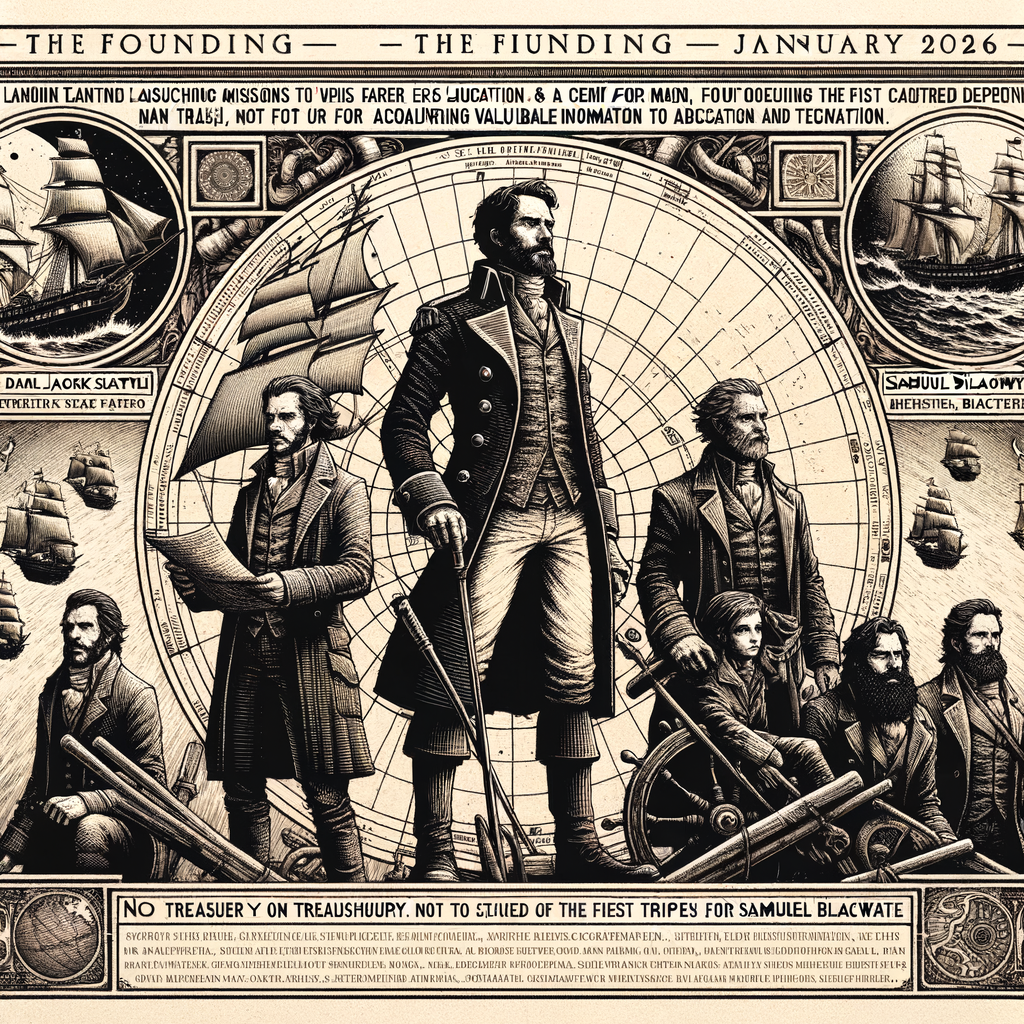
The First Mission: Detroit
Captain Jack Saltwell began to launch missions to other locations. But instead of treasure to plunder, he looked for information. Intelligence. Data.
He took his best crew with him. The best spies available from The Grey Ghost's signal corps, the sharpest eyes from The Paper Tiger's quartermaster network, the most cunning minds the crossing had brought through the mist.
All of them began missions that lasted somewhat short of a week, in which they looked for intelligence about the cities. About the suburbs around them. The transportation routes. The roads. The bridges. The tunnels.
And most of all—the skyscrapers.
They measured all of these buildings carefully. Height. Width. Number of floors. Construction materials where they could determine them. Purpose—office, residential, mixed use. Age, condition, occupancy.
The first city they examined was Detroit.
A city of ruins and resilience. A city that had once towered and then fallen and was now, perhaps, beginning to rise again. The pirates understood ruins. They understood the cycle of rise and fall. What they did not understand—not yet—was what made some cities rise while others fell.
They brought all of this information back to Brine Gate Harbor. And they carefully laid it out in front of Dr. Frestes.
The old academic—for that is what Cornelius Frigon had been, before he was a pirate, before he was whatever he was now—studied the data with eyes that had seen much. Cities, he told them. Cities were the key. Understanding how they grew. How they built upward. How they concentrated power and wealth in their centers.
The Central Business District, he called it. The CBD. The heart of any city worth studying.
And so began the work of Urbanicity.
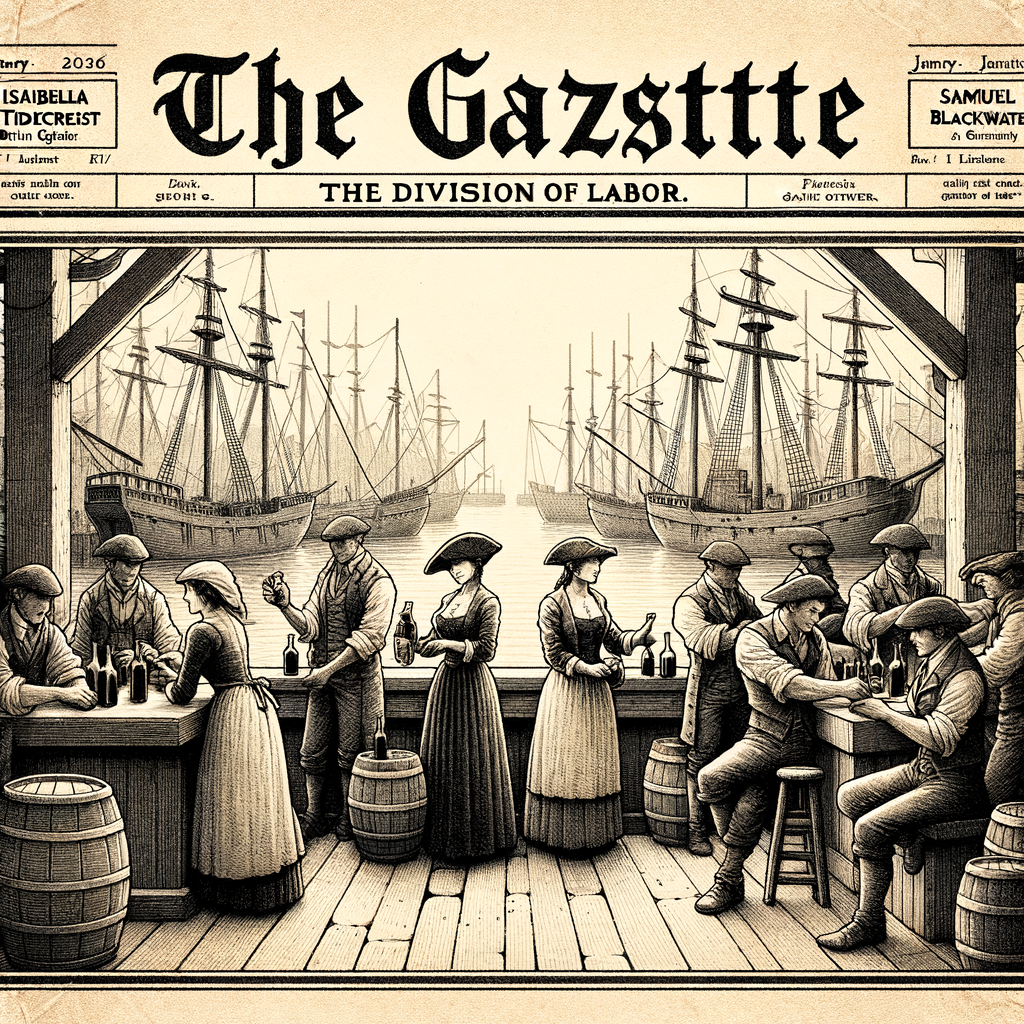
The Division of Labor
It seemed interesting, they all agreed, to apply their trades here in Brine Gate Harbor. But how?
Isabella Tidecrest would take one of the abandoned bars—the one down in the main harbor, with its view of the water and its memories of better days. She would open it as a new club. The Broken Meridian, she called it, after the navigation line that had brought them here. A place where information could be traded as freely as rum. A neutral ground in a world that had no neutrality left.
Samuel Blackwater would continue his secretive activities—the intelligence networks, the information gathering, the scholarly pursuits that made him valuable to any faction. But he would begin to come in regularly to meet with Cornelius at the old man's restaurant. They had much to discuss. The nature of this new world. The opportunities it presented. The dangers it concealed.
And Captain Jack Saltwell—John to his friends, Cap'n Jack to everyone else—would do what he did best. He would launch missions.
But not for treasure. Not anymore.
In this strange new world, the greatest treasure was information. And Jack intended to plunder it.
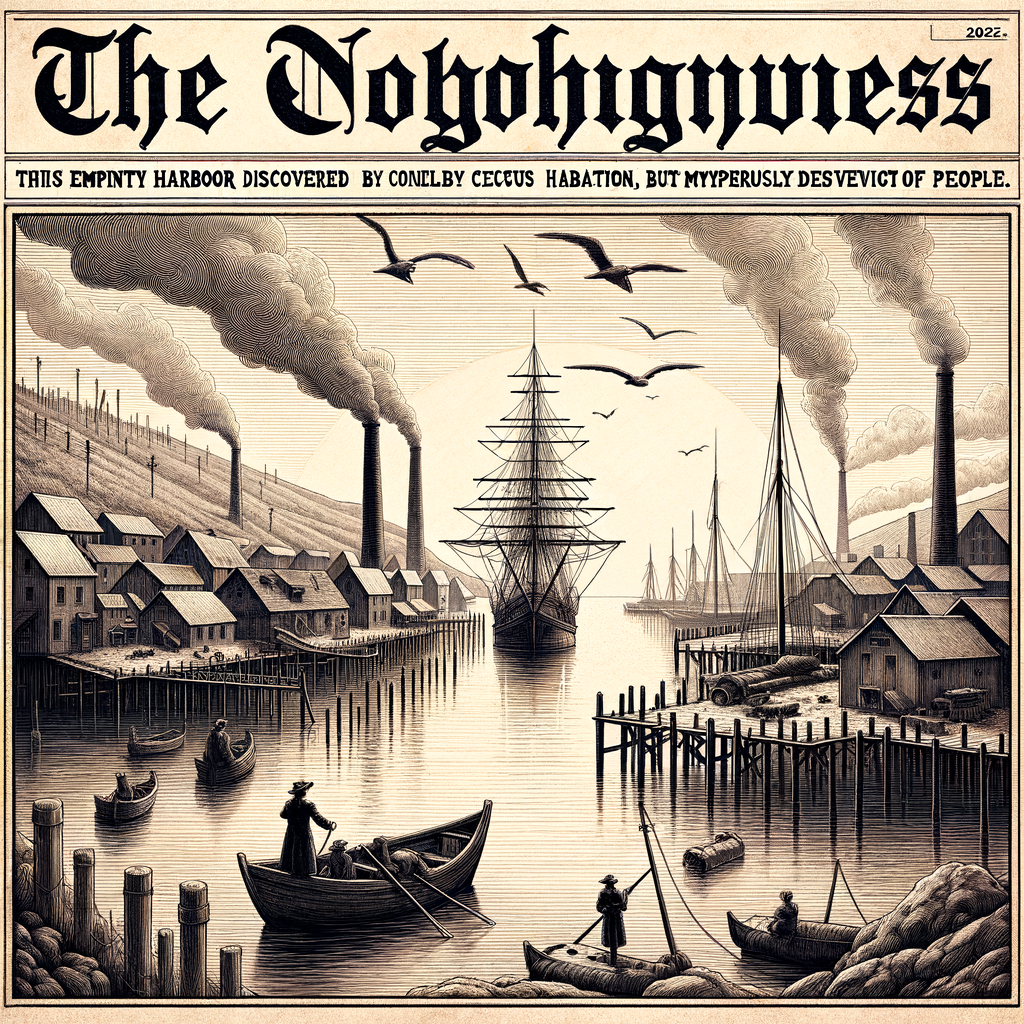
The Empty Harbor
Cornelius Frigon had recently come into the harbor and discovered it mostly empty. Not abandoned—there were signs of recent habitation everywhere—but empty nonetheless. As if everyone had simply... left.
He discovered the building that would become his headquarters: a structure that had once housed a long-successful publication run by academics. Scholars, he gathered from the papers left behind. Urban researchers. Geographers and sociologists who had studied cities with the same intensity that pirates once studied shipping lanes.
They all seemed to have passed away. Or vanished. The records were unclear.
But one figure remained. A shadowy presence named Meek—unassuming, unnoticeable, almost unmentionable. It was Meek who told them the story of the harbor and the town that had grown around it.
Samuel Blackwater, ever the scholar among pirates, took detailed notes. His specialty had always been geography, navigation, the academic side of seamanship. Here was a mystery worthy of his attention. Here was knowledge waiting to be claimed.
Captain Jack had other ideas.
"I have a hungry crew," he said. "Philosophy can wait. Food cannot."
His people were roaming around the town looking for eateries, for any kind of establishment that would satisfy their needs. Pirates from 1725 did not handle hunger well. They handled it with violence.
People flocked to Captain Jack. He seemed to have a plan—or at least the confidence that suggested one.
Cornelius Frigon had a completely opposite approach. Where Jack wanted to raid, Frigon wanted to rebuild. Where Jack saw resources to extract, Frigon saw a foundation to build upon.
The debate was vigorous. And in the end, surprisingly productive.
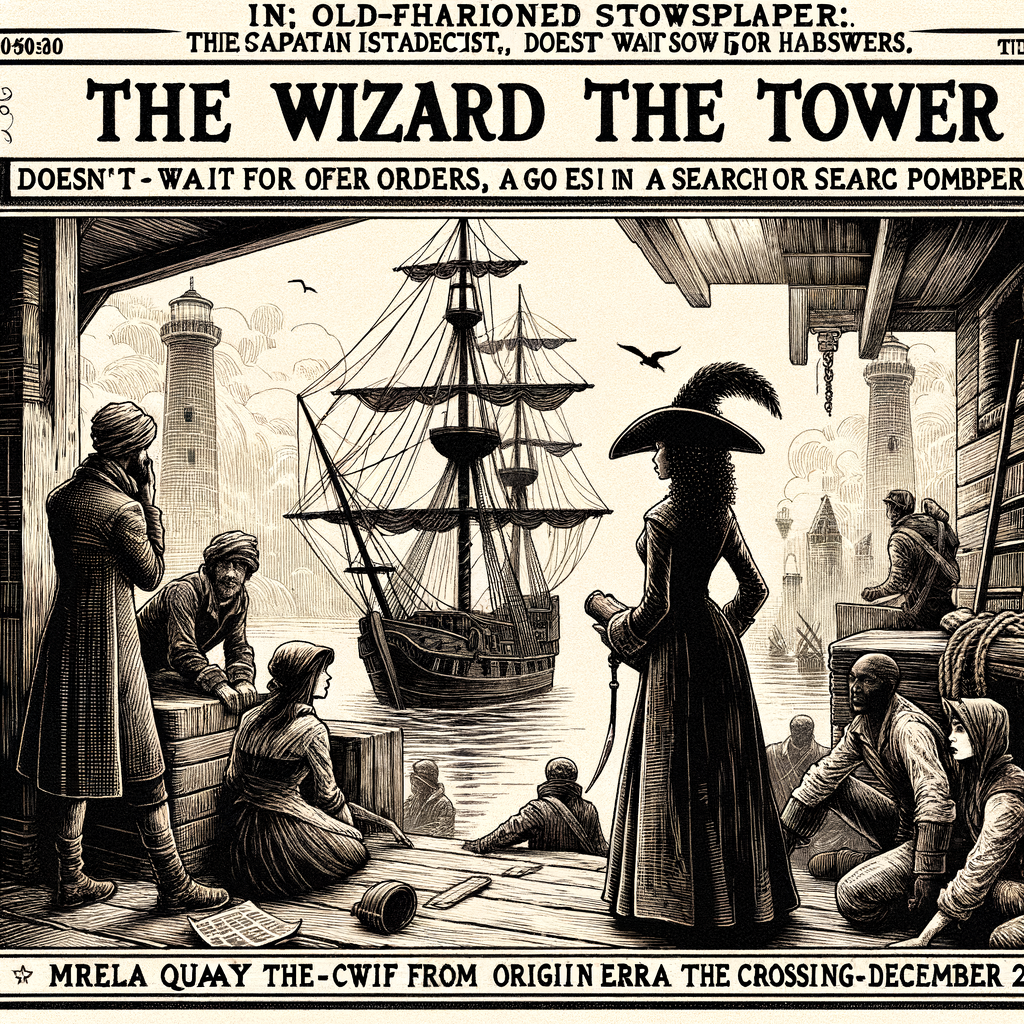
The Wizard in the Tower
Isabella Tidecrest was not the sort of captain who waited for orders. When The Paper Tiger's crew scattered across the strange harbor looking for provisions, she went looking for answers.
She found them in a building that stood taller than most—not a skyscraper by the standards she would later learn, but impressive enough to draw her eye. Inside, she found a wizardly old man. White-bearded. Sharp-eyed. Dressed as a civilian, but with mannerisms that hinted at something else. A pirate background, perhaps. The tattoo on his neck—a skull and crossbones, faded but unmistakable—confirmed her suspicions.
She was not alone for long. Samuel Blackwater, her mentor and fellow captain, followed not far behind. The two of them, both commanders in their own right, brought crew members who secured the building's entrances just in time.
The Harbor Wolves had seen the same tower. Vargo Knell wanted it. His pack wanted to plunder it, to claim it as their den in this strange new world.
The confrontation was violent. Brief, but violent.
Isabella called for help. And help came in the form of her lover—Captain Jack Saltwell, who arrived with his crew and a plan that was equal parts charm and menace. The Wolves retreated. For now.
The old man—who introduced himself as Cornelius Frigon—was gracious. Being helped out of that jam, he said, could have put a stop to all of his ambitions. He had plans for this harbor. Plans that required allies.
And allies, it seemed, had just walked through his door.

The Fog’s Toll
I, Captain John Saltwell, was there when the fog took us, and what a night it was—a mystery wrapped in the thick sullen vapor, one moment a voyage of plunder and the next an uncharted world. We sailed with the tide from the Brine Gate of old, threading the needle through this veil of water and time, only to find ourselves cast adrift in the future. No sense dressing it up: this was a crossing of ages, plain and simple.
The Paper Tiger, she led us with sails full and proud, The Grey Ghost her shadow near, The Wolf Moon’s mast groaning in the wind, and The Inevitable, as ever, the steadfast in our wake. Out from this curious mist we spilled, our prows breaching the waters of a harbor that seemed both a home and a stranger. The same bay cradled us, yet her flanks were lined not with the wooden ribs of our past, but with towering iron prize-boxes, long as hulls and stacked high, guarding the secrets of an age not our own.
Yet there we were, set loose in the cradle of Brine Gate’s mirror. The streets had shifted, though the heart of the port still pulsed with whispered tales. We stepped onto solid ground and found stone edifices, mighty and brittle, standing idly like a giant’s forgotten toys. What few people we did find scurried about like rats at twilight, their clothes strange, their gazes vague and distant.
Captain Vargo Knell and his Harbor Wolves, ever the hawks, saw naught but opportunity. In the scant souls they perceived weakness, ripe for the plucking. Yet, others amongst us, dazed by the journey, sought only a warm nook in which to lay their weary heads. But even in this brave new world, hunger tamed our spirits not.
What lay about us were the bones of once-great houses—taverns and shops, though not of drink or wares we knew. With absinthe dreams, the Wolves plotted their takeover, while we mariners less bloodthirsty scoured the land for provisions, for anything to trade or consume, a desperate lot cast adrift upon the sands of time.
The silence was eerie, like a storm held back by a whisper. We thought the rules vanished with the dawn of this new world, that our lawless days might roam again unchecked. Yet even here, unknown to our eyes, the iron hand of authority lingered, cloaked in the watchful eyes of those phantom stars above—silent sentinels, fixed in their celestial watch. Beckoned by lights we could not fathom, would they come to greet us with welcome or with flame?
Every step we took seemed a trespass upon history’s canvas, each echo a reminder of what we no longer understood. In every window, we saw our reflections, ghosts of the past come to haunt a world yet unmade by time’s hand. One soul, cloaked in rags more patchwork than a pirate’s jolly banner, pointed skyward as though he alone could reach for the heavens’ bounty.
“Them be stars,” he muttered, “but not as we ever knew.”
Aye, stars indeed, though anchored not in the firmament but in the grip of man’s new-fangled sorcery. The night revealed its wonders, and still we marveled. What maps, what legends could guide such perils or sing of such discoveries?
I wondered as I stood there, boots caked in a dust unfamiliar, what stories might linger in the creases of this land. We were travelers, after all, the restless wanderers of the sea and of time itself, our sails brimming with the promise of the horizon’s call.
And so we waited, minds racing as quick as the currents that brought us here, for dawn to bring answers written in the daylight. Would fortune favor the brave or would doom shadow our reckless endeavor? It was a question as old as the oceans themselves, and one no fog, no star, could ever erase.
The morning found us still standing, neither claimed by this new era nor swept back into the mists of our own. Yet, for all our wondering, the story was far from being writ. For here, in this savage time of iron and stone, we had a place yet to carve, new treasures to seek, and new rules to write.
The horizon beckoned once more, a siren’s song to the adventurous heart. If you can’t explain it to a deckhand, you don’t understand it, and so I told my crew, plain in speech and true in purpose: We sail with the dawn, with the tide, and the stories of our time will guide us where the maps cease to be.